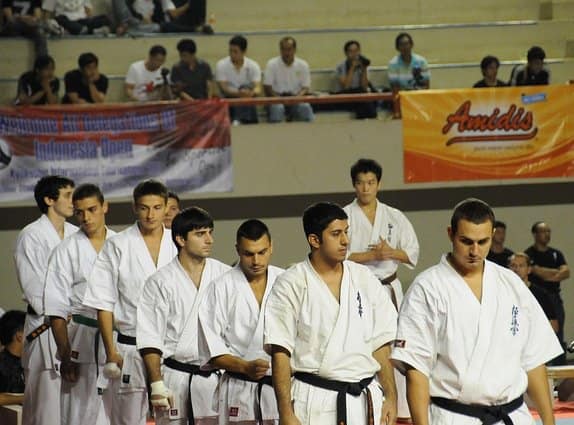
Full-contact punches to the head. Low kicks. Knees. Throws. Chokes. Armlocks.
All under one ruleset.
In a gi.
With the discipline of Japanese budo.
Kudo is the martial art many people discover after asking a simple question:
What happens when a full-contact striker and a Judoka stop taking turns?
The answer is more complex than “Kyokushin plus Judo.”
Those are Kudo’s clearest roots. But Kudo has grown into its own complete system, with its own head striking, gripping, throws, groundwork, transitions, protective equipment, competition rules and grading.
As of July 2026, we cannot verify an officially affiliated Kudo dojo operating in Auckland or elsewhere in New Zealand.
Auckland City Kyokushin does not claim to teach Kudo.
What we can offer is an honest first step.
Build a strong body and a serious full-contact striking foundation through Kyokushin. Add dedicated Judo for breakfalls, gripping, balance breaking, throws and groundwork. Then, when qualified Kudo instruction becomes accessible, learn how those ranges are properly connected.
That combination will not magically make you a Kudo practitioner.
But it means you will not be starting from zero.
The martial art most New Zealanders have never seen
Kudo — written Kūdō or 空道 — is a modern Japanese mixed budo.
The Kudo International Federation defines it as a full-contact system incorporating punches, kicks, throws and submission techniques on the ground. It is also presented as more than competition: Kudo retains reigi, the respect and etiquette of Japanese budo, alongside physical training and character development.
That distinction matters.
Kudo is not simply an assortment of effective techniques.
It asks the practitioner to handle every major range:
Strike from distance
Defend and attack in the pocket
Clinch while strikes remain possible
Establish and break grips
Disrupt posture and balance
Throw a resisting opponent
Control the transition to the ground
Attack, defend or escape in newaza
Move between all those phases before the opponent can settle
Most martial arts become deep by specialising.
Kudo tries to become complete by integrating.
And that integration is where the real difficulty begins.
Is Kudo just MMA in a gi?
It can look that way.
Kudo allows fighting across striking, throwing and ground ranges, so the comparison with mixed martial arts is understandable. Adult competition can include punches and kicks, throws, chokes and joint locks, with specialised protective equipment allowing a broader striking ruleset than most traditional karate competition.
But Kudo has its own identity.
It is practised in a gi. It has Japanese dojo etiquette, kyu and dan grades, a distinct competition system and a philosophy grounded in budo. The official organisation describes it not only as a combat sport, but as a lifelong discipline concerned with self-control, respect, resilience and personal development.
Kudo is therefore neither ordinary knockdown karate nor cage MMA wearing Japanese clothing.
It is a modern mixed budo built to connect realism, safety, competition and character.
Kudo’s roots are exactly where they look
Kudo was founded by Takashi Azuma.
Azuma was a third-dan Judoka who joined Kyokushinkaikan headquarters in 1972. He competed at the highest level of full-contact karate and won the 9th All-Japan Full Contact Karate Open Championship.
In 1981, he founded Daido Juku and proposed kakuto karate — combat karate built around greater realism, controlled safety and a broader range of techniques.
In 2001, the system was introduced internationally as Kudo, and the first World Kudo Championship was held.

Kudo did not appear from nowhere.
It was created by somebody who understood both the pressure of full-contact Kyokushin and the mechanics of Judo.
The inheritance is clear:
Kyokushin contributed hard-contact striking, powerful kicking, physical conditioning and budo discipline.
Judo contributed gripping, kuzushi, throws, breakfalls, positional control and submission grappling.
But Azuma did not simply place one class beside another.
He built a system in which the ranges collide.
That changes everything.
"Kyokushin plus Judo” is useful shorthand — but it is not the whole art
Calling Kudo “Kyokushin plus Judo” gives a newcomer a quick mental picture.
Historically, it makes sense.
Technically, it is incomplete.
A Kyokushin fighter learns to strike under pressure.
A Judoka learns to grip, unbalance, throw and grapple under resistance.
A Kudo practitioner must do those things while the threat changes from one second to the next.
Knowing how to throw is not the same as entering a throw while punches, knees or elbows may be coming.
Knowing how to punch is not the same as punching while somebody controls your sleeve and collar.
Knowing newaza is not the same as attacking immediately after a hard throw under a short ground-fighting period, with striking-related scoring built into the rules.
The ingredients may be familiar.
The transitions are not.
Kudo has developed its own stance, guard, timing, grip strategy, scoring actions, protective equipment and tactical answers for these collisions.
The integration is not an optional extra.
The integration is the art.
What experienced Kudo practitioners told us
Because official Kudo instruction is currently difficult to access in New Zealand, we asked several experienced Kudo practitioners, black belts and branch leaders what somebody in Auckland should do first.
Their exact recommendations varied according to the arts available locally and the individual student’s background.
But underneath those differences was a remarkably consistent message:
Build real ability at every fighting distance. Develop physical strength. Then let a qualified Kudo coach teach you how to connect the ranges and correct what is missing.
Several strongly encouraged continuing with Kyokushin.
Several described Kyokushin as a central foundation within Kudo.
Another emphasised the strong body and legs, ability to withstand contact, striking power and variety of kicks that Kyokushin develops.
Others highlighted the value of Judo for posture, gripping, throws and submission preparation that can eventually blend with striking.
They were equally clear about the limitation:
Training two separate martial arts does not automatically create Kudo.
You can become competent in striking and competent in grappling while still struggling to move smoothly between them.
That is normal.
Your foundation gives you tools.
A future Kudo instructor teaches you how the tools fit together.
What Kyokushin gives a future Kudo practitioner
Kyokushin develops qualities that are difficult to imitate through occasional cross-training.
A body accustomed to contact
Kyokushin conditions the torso and legs to remain functional under impact.
This does not make anyone invulnerable. It changes how the body and mind react when a fight becomes physical.
Contact is no longer a surprise.
Powerful, varied kicking
Low kicks, body kicks, knees, front kicks, round kicks, side kicks, back kicks and spinning attacks give the Kyokushin practitioner a broad kicking vocabulary.
Kudo contains more ranges, but a strong kicker enters with a serious weapon already developed.
Striking mechanics that survive pressure
Posture, balance, hip rotation and correct striking surfaces must continue to work when the opponent is resisting and returning fire.
Clean technique in the air is not enough.
Close-range composure
Kyokushin kumite teaches students to stay present in crowded, uncomfortable exchanges rather than immediately retreating or mentally freezing.
That composure matters when striking begins to merge with gripping.
Conditioning that changes decision-making
A tired fighter chooses badly.
Consistent Kyokushin training develops the legs, trunk, breathing and mental endurance needed to keep making technical decisions under pressure.
A shared budo language
Kudo is not only a combat ruleset. It retains Japanese etiquette, grading, dojo culture and the expectation that training should develop character.
Kyokushin students already understand repetition, hierarchy, respect, kiai, kihon and the long process of earning competence.
Kyokushin does not teach Kudo.
But it gives a future Kudo practitioner a serious base from the same full-contact family that helped produce it.
What Judo adds that striking cannot
A strong striker can still feel completely lost the moment an experienced grappler controls the gi and breaks their posture.
Judo changes that.

Judo develops gripping, balance breaking and throws under resistance — skills that striking alone does not provide. Pictured: Auckland University Judo Club, Auckland.
It teaches an entire fighting language:
Ukemi: falling, rolling and protecting the body
Posture: remaining difficult to move while positioning the opponent
Kumi-kata: establishing, denying and changing grips
Kuzushi: breaking balance before attempting a throw
Tsukuri and kake: entering and completing throwing mechanics
Ashi-waza: sweeps, reaps and foot attacks
Hip and hand throws: connecting the body to a resisting opponent
Pins and escapes: controlling or surviving on the ground
Chokes and armlocks: finishing from appropriate positions
Randori: applying technique against somebody actively trying to stop it
These are not side skills that can be mastered through a few takedown drills after karate class.
They require specialist instruction and resistant practice.
Several Auckland City Kyokushin members also train at Auckland University Judo Club in Epsom. The club is listed by Judo New Zealand, and the Auckland Judo Association describes its approach as combining contemporary Olympic Judo with Kosen-influenced Judo newaza to develop well-rounded Judoka.
That makes it a logical local complement for a Kyokushin student who wants serious throwing and ground development.
A technical warning for serious cross-trainers
Separate arts do not always connect automatically.
One experienced Kudo instructor raised a subtle example: a student who habitually uses one lead leg in grappling but the opposite lead in striking may initially find the transition between those skills awkward.
That does not mean every beginner should immediately force both arts into one stance.
It means integration should eventually be deliberate.
Stance, posture, guard and footwork must make sense when the rules allow both striking and grappling. A qualified Kudo coach can help resolve those conflicts later.
This is another reason Kyokushin and Judo should be understood as a foundation — not a homemade replacement for Kudo.
What official Kudo instruction still has to add
Even a capable Kyokushin practitioner with solid Judo would still need to learn Kudo itself.
That includes:
Defending and delivering punches to the head under Kudo equipment
Adapting the guard and stance to both strikes and takedowns
Entering grips without absorbing clean strikes
Striking while using the gi to manipulate posture
Creating kuzushi through strikes, movement and feints
Throwing when the grip period is short
Following throws with immediate scoring actions
Escaping or attacking during time-limited groundwork
Defending strikes from inferior ground positions
Blending submissions with striking-related threats
Understanding Kudo’s scoring, penalties and competition strategy
Learning its grading standards, etiquette and technical vocabulary
The official KIF explanation notes that standing grips must be converted into action quickly, groundwork is time-limited, and simply holding a pin does not produce the same result as it does in Judo.
Speed matters.
Transitions matter.
The ability to recognise an opening before the opponent can reset matters.
In Kudo, higher skill is not merely a longer list of techniques.
It is better integration across skillsets.
What actually happens in Kudo competition?
Kudo competition is designed to allow a broad range of realistic actions while using rules and equipment to control risk.
The official summary describes victory through effective full-contact strikes, throws, scoring actions and submissions. Rules differ by age, sex and competition division, and younger divisions restrict techniques that are permitted in adult categories.
Purpose-designed headgear and other protective equipment allow Kudo to include head striking while maintaining a structured sporting environment.
That does not make Kudo harmless.
No responsible full-contact martial art should promise that.
It means the system has deliberately tried to balance breadth, realism and safety.
The fighting problem Kudo tries to solve
Range
What the practitioner must handle
Distance, kicking, entries and exits
Guard, combinations, defence and pressure
Strikes, grips, posture and rapid attacks
Kuzushi, entries, finishing mechanics and landing control
Position, submissions, escape and striking-related scoring
Moving between all ranges before the opponent can settle
Most martial arts specialise.
Kudo integrates.
That breadth is its attraction — and the reason proper instruction cannot be replaced by watching videos and mixing techniques casually.
Kudo vs Kyokushin vs Judo
Category
Kyokushin
Judo
Kudo
Primary strength
Full-contact striking, conditioning and pressure
Gripping, throws, pins and submissions
Integrated striking, clinch, throws and groundwork
Head punches
Not permitted in standard knockdown competition
Striking is not part of standard competition
Permitted in applicable divisions with protective equipment
Low kicks and body attacks
Central
No
Central
Clinch and gripping
Limited within standard knockdown competition
Central
Integrated with striking
Throws
Not central to standard knockdown rules
Central
Integrated with entries, strikes and follow-ups
Groundwork
Not part of standard knockdown competition
Pins, chokes and armlocks
Time-limited groundwork, submissions and striking-related scoring
Core training identity
Full-contact karate
Throwing and grappling budo
Integrated mixed budo
Best reason to train it
Build a deep striking base
Build a deep throwing and grappling base
Learn to connect the ranges under one system
There is no need to insult one art to explain another.
Kudo exists because specialist arts are powerful — and because fighting changes when their specialist ranges meet.
Can you train Kudo in Auckland or elsewhere in New Zealand?
As of July 2026, the Kudo International Federation’s public affiliated-country list includes Australia but does not list New Zealand.
We have also been unable to verify an officially recognised Kudo branch operating in Auckland or elsewhere in the country.
That does not prove nobody in New Zealand informally studies Kudo footage or Kudo-inspired material.
It means students should be careful with official claims.
Before joining anybody advertising Kudo, ask:
Is the instructor recognised by Daido Juku or the Kudo International Federation?
Can the branch be verified through the official organisation?
Who issued the instructor’s Kudo grade?
Does the class teach the official curriculum or only Kudo-inspired drills?
Can students access recognised gradings, seminars and competition?
Is the instructor authorised to represent Kudo publicly?
A rare martial art is especially vulnerable to people borrowing its name without its lineage.
Auckland City Kyokushin teaches Kyokushin.
We do not issue Kudo grades, claim Kudo affiliation or advertise ordinary cross-training as official Kudo.
That distinction protects students and respects the art.
The most practical Kudo foundation available in Auckland
There is no perfect substitute for Kudo.
But there is a sensible way to prepare.
Step 1: Build the striking base properly
Start with Kyokushin.
Learn stance, movement, body mechanics, low kicks, knees, body punching, defence, conditioning and composure under pressure.
Do not rush to become “well-rounded” before becoming good at anything.
Depth first.
Still comparing striking systems? See our honest breakdown of Kyokushin vs Muay Thai vs Kickboxing in Auckland.
Step 2: Add dedicated Judo
When your Kyokushin routine is stable, add Judo under qualified coaches.
Learn to fall before chasing spectacular throws.
Learn gripping before trying to blend strikes into the clinch.
Learn position before chasing submissions.
The goal is not to collect moves.
It is to build skill that survives resistance.
Step 3: Develop physical strength
Technique matters most when the body can support it.
Strengthen the legs, hips, trunk, grip, neck and upper back. Build aerobic capacity and the ability to repeat hard efforts.
But do not let extra training destroy the consistency of your martial arts practice.
Two arts trained deeply are usually better than three or four trained sporadically.
Step 4: Seek authorised Kudo instruction
Australia is currently listed as an affiliated Kudo country and is the nearest established pathway.
An open seminar, travel to an authorised dojo or instruction arranged through the official organisation would be the correct way to begin learning Kudo-specific integration.
Step 5: Let the Kudo coach identify the gaps
A striker may need extensive head-punch defence and takedown awareness.
A Judoka may need distance management and composure under strikes.
A strong athlete may still have poor transitions.
Your existing arts give you advantages.
Your Kudo coach teaches you where those advantages fail.
Possibly.
The ingredients already exist:
A serious full-contact karate community
Strong Judo clubs
Growing interest in mixed-range martial arts
Geographic access to established Kudo activity in Australia
Martial artists who value budo as well as combat effectiveness
But it should grow in the right order.
First, develop capable students.
Then build relationships with recognised instructors.
Then host qualified technical instruction.
Then determine whether there is enough sustained commitment for an official branch.
The KIF pathway for establishing a branch involves formal contact, application, participation in technical seminars or headquarters instruction, examination, membership administration and branch certification.
A legitimate New Zealand Kudo pathway would therefore require a real relationship with the official organisation.
Not a new logo.
Not a weekend experiment.
Not somebody awarding themselves a Kudo belt.
Proper instruction. Proper recognition. Proper lineage.
Auckland City Kyokushin is open to genuine learning and future collaboration.
We will not present ourselves as something we are not.
That is not hesitation.
That is budo.
This approach may suit you if:
Kudo has caught your attention but you cannot access official training in New Zealand
You want full-contact striking without abandoning Japanese budo
You want serious throwing and groundwork rather than occasional takedown drills
You are willing to build specialist foundations before combining them
You care about verified instruction and legitimate lineage
You want demanding, technical and honest training
It may not suit you if:
You only want to say that you train Kudo
You expect two memberships to make you a complete fighter
You want an immediate shortcut to mixed martial arts
You are unwilling to spend years developing fundamentals
You need an official Kudo grade immediately
There is no shortcut hidden inside a hybrid martial art.
There are simply more places where weak fundamentals can be exposed.
Is Kudo just Kyokushin karate plus Judo?
That is useful shorthand for its roots, but not a complete description of modern Kudo. Founder Takashi Azuma had high-level Kyokushin and Judo experience. Kudo later developed its own integrated tactics, head striking, grip rules, transitions, equipment, competition system and grading.
Is Kudo the same as MMA?
No. Both include striking, takedowns and ground fighting, but Kudo is a distinct Japanese budo practised in a gi, with its own etiquette, grading structure, protective equipment and competition rules.
Can I train Kudo at Auckland City Kyokushin?
No. We teach full-contact Kyokushin karate and do not issue Kudo grades. Our training can provide a serious striking and conditioning foundation for somebody who wants to pursue official Kudo later.
Is there an official Kudo dojo in New Zealand?
We cannot verify one as of July 2026, and New Zealand does not appear on the Kudo International Federation’s April 2026 public list of affiliated countries. Check the official KIF list because this may change.
Where are you based?
We train in the Auckland CBD, across the Ellen Melville Centre and HIYOGA Studio (Level 2, 125 Queen Street). Our main Kyokushin classes run Tuesday and Thursday evenings, with additional invitation-only sessions.
Is Kyokushin a good foundation for Kudo?
Yes. Kyokushin develops powerful kicking, body striking, conditioned legs and torso, pressure tolerance, balance, discipline and composure. It is also historically connected to Kudo through founder Takashi Azuma. However, it does not replace official Kudo instruction.
Why add Judo to Kyokushin?
Judo develops breakfalls, posture, gi grips, balance breaking, throws, pins, chokes, armlocks and resistant grappling. These skills complement Kyokushin’s striking particularly well, although Kudo instruction is still required to integrate them safely under striking pressure.
Do I need to train several martial arts before starting Kudo?
No. Experienced practitioners come from many backgrounds. When Kudo is unavailable, it is usually better to develop two compatible foundations consistently, build physical strength and later let a qualified Kudo coach identify the missing areas.
Will Kyokushin and Judo make me a Kudo fighter?
No. They can give you valuable striking and grappling foundations. Kudo still requires its own head striking, stance, transitions, grip tactics, scoring, equipment, rules and grading.
Does Kudo allow punches to the face?
Yes, in applicable divisions. Kudo uses specialised protective equipment to include head striking within its competition system. Rules differ by age and division, and younger competitors have additional restrictions.
Could Auckland City Kyokushin become a Kudo branch?
Only through a legitimate process with Daido Juku and the Kudo International Federation, including technical instruction, assessment, membership requirements and formal branch recognition. We would not rebrand ordinary cross-training as official Kudo.
Is Kudo safer than MMA?
It is more accurate to say that Kudo uses protective equipment and rule controls intended to balance realism and safety. It remains full-contact combat training, and injury risk cannot be removed. Coaching, supervision, intensity management and individual behaviour all matter.
Start with what can be trained properly
Watching Kudo can make you want everything at once.
Punches.
Kicks.
Throws.
Submissions.
An answer for every range.
But completeness without depth is only a larger collection of weaknesses.
Start with a striking art that makes technique survive pressure.
Add a grappling art that makes control survive resistance.
Then, when qualified Kudo instruction becomes accessible, learn how to connect them properly.
At Auckland City Kyokushin, we teach the first part honestly:
Full-contact Kyokushin. Strong bodies. Clean fundamentals. Hard conditioning. No shortcuts.
The only way to understand it is to feel it.
Ready to start the foundation?
Official Kudo instruction may not currently be available in New Zealand. But the first part of the foundation is. If you want serious full-contact Kyokushin — striking, conditioning, discipline and pressure — that’s what we train in Auckland CBD.
OSU.