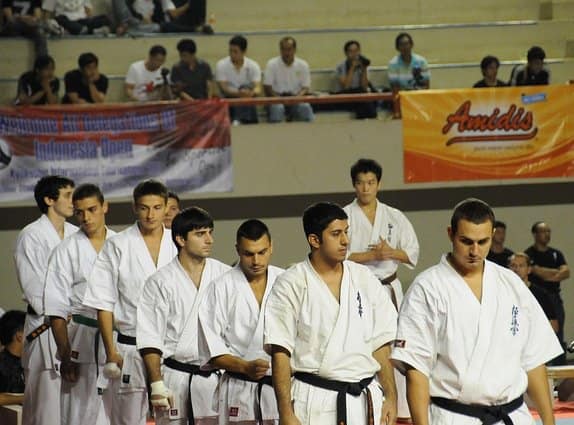
Pilates, Yoga & Recovery for Martial Artists in Auckland

Kyokushin is hard on the body. That's the point. Bare-knuckle conditioning, low kicks, knockdown sparring — it builds power the honest way, and it leaves a mark.
Training hard for one year is easy. Training hard for ten is the real test. That takes a body that recovers, a core that holds under pressure, and hips that still move when you're forty.
This is the part of training most dojos never talk about. We do — because it's the difference between a fighter who burns bright for two years and one who's still on the mat a decade later.
No fluff. No fitness-class spin. Just what actually keeps you training.
The thing nobody tells you about hard training
Walk into most striking gyms and the message is simple: train harder. More rounds, more conditioning, more contact.
It works — right up until it doesn't. Tight hips rob your kicks of height and power. A weak core leaks force on every strike and leaves your spine exposed to the body shots Kyokushin is famous for. Old injuries that never properly healed flare up. And the recovery that came easy at twenty takes a week at thirty-five.
None of that means train less. It means train smarter alongside the hard work — so the hard work keeps paying off instead of breaking you down.
That's what cross-training is for. Not a soft alternative to the dojo. The thing that keeps you in it.
Pilates was built for fighters — literally

Here's something most people don't know.
Pilates wasn't born in a wellness studio. Joseph Pilates was a boxer. He trained as a fighter in England before the First World War, taught wrestling and self-defence, and grew up studying boxing and jiu-jitsu. When he later built his method in New York, his first clients included professional boxers — and his gym sat in a building full of athletes.
He called the centre of the body the "Powerhouse" — and taught that every punch should be initiated from there, not the arm. Core first. Power from the centre. Strikes that carry the whole body behind them.
If that sounds familiar, it should. It's the same principle behind every clean Kyokushin technique. Pilates and karate were chasing the same thing from the start: power generated from a strong, controlled centre.
A century of marketing turned Pilates into something else in the public eye. But strip that away and you're left with exactly what a striker needs.
What Pilates actually does for your Kyokushin
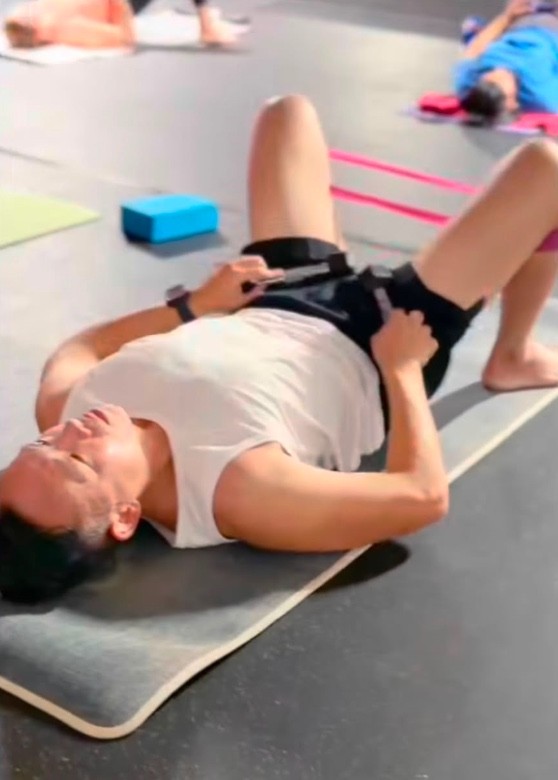
This isn't about touching your toes. It's about specific, measurable carryover to how you fight:
A stronger core means harder strikes. Power in Kyokushin comes from the ground, through the hips, out through the fist or shin. A weak link in that chain bleeds force. Pilates builds the deep stabilising muscles — not the show-muscle six-pack, the ones that actually transfer power and protect your spine when you take a body shot.
Better balance and control. Every kick is a moment on one leg. Every combination is controlled movement under load. Pilates trains exactly this — stability, coordination, and body awareness — so your technique holds up when you're tired and under pressure.
Fewer injuries, faster recovery. Pilates strengthens the connective tissue around your joints and corrects the muscular imbalances that hard one-sided training builds up. That's fewer tweaks, fewer layoffs, and more consistent time on the mat — which is the only thing that actually makes you better.
A longer career. Conditioning that protects the body is conditioning that lets you keep training. The strongest karateka aren't just tough — they're durable.
And the yoga side: mobility, breath, recovery
If Pilates builds the engine, mobility and recovery work keep it running.
Hips and high kicks. The single biggest physical limiter on most strikers' kicks isn't strength — it's hip mobility. Tight hips cap how high and how freely you can kick, and force compensations that show up as lower-back and knee pain. Targeted mobility work opens that up.
Breath under pressure. Every martial artist knows the person who gasses in round two. Breath control — the core of yoga practice — directly trains stamina and the ability to stay calm when your heart rate spikes. Calm breath, clear head, controlled body. That's a fighting skill, not a relaxation one.
Recovery between hard sessions. Long, deep stretching and restorative work flush tension out of overworked muscles and let connective tissue rebuild. It's how you back up Tuesday's session on Thursday without carrying the damage.
And to head off the obvious objection: this isn't slow, soft, or a substitute for the hard rounds. It's the maintenance that lets you keep doing the hard rounds. The toughest fighters in the world cross-train this way — not because they've gone soft, but because they intend to last.
The HIYOGA connection — and why it's one of our own
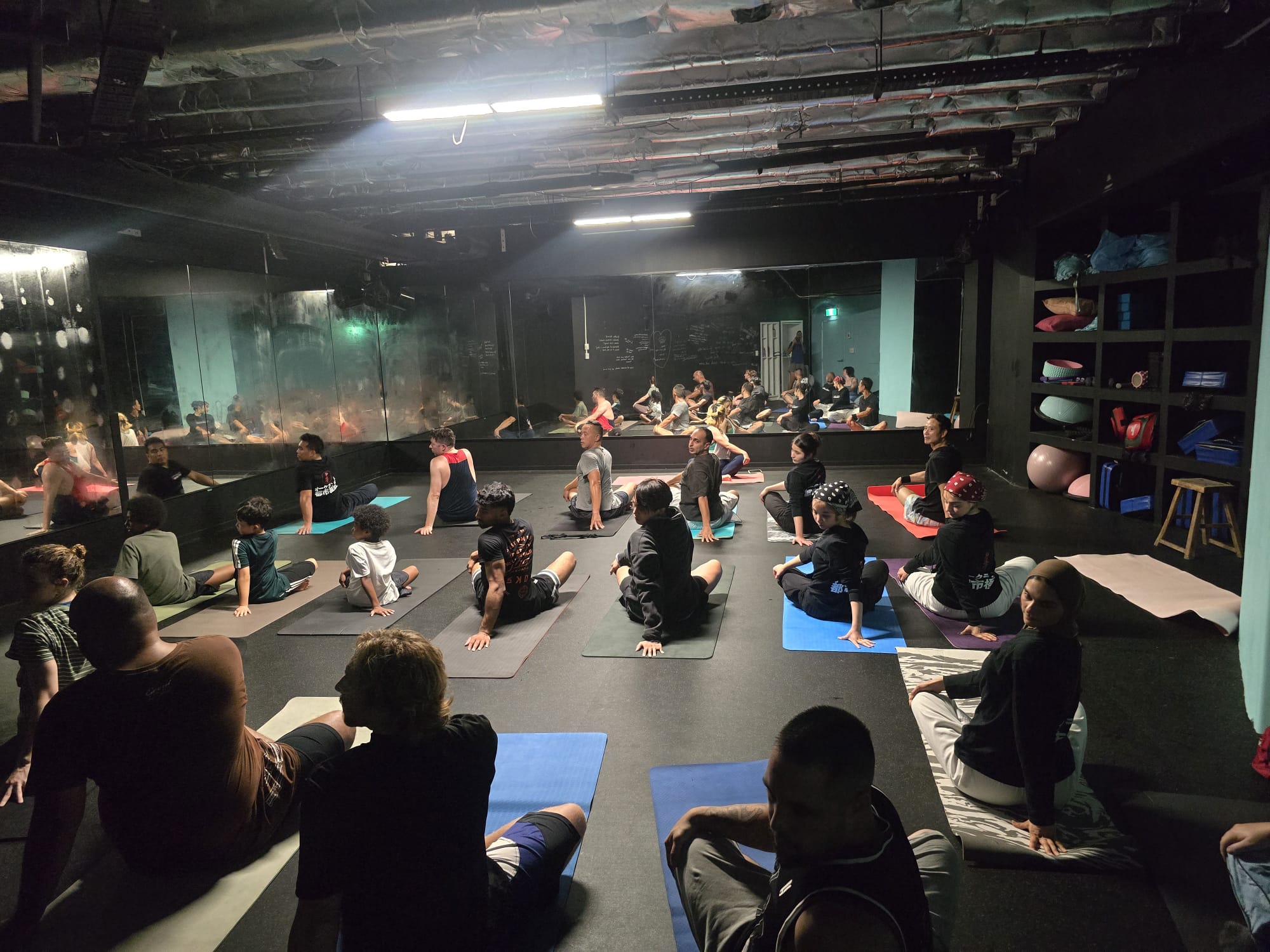
If you've looked around our site, you'll have seen HIYOGA listed as one of our training venues, alongside the Ellen Melville Centre. Here's the story behind it.
One of our own — Isabella (Bella to us) — is a senior member of the dojo and a highly regarded movement instructor at HIYOGA in the Auckland CBD. She came up through years of yoga and Pilates: Bikram and Ashtanga yoga, a Pilates teaching background, personal-training coaching, and full REPs certification (Registered Exercise Professional). She also coaches in English or Mandarin, whichever you prefer.
Through Bella, we arranged with HIYOGA to use their space — including a session in the heart of the city. It's a genuine link between our dojo and a quality studio, through someone who trains on our floor and understands exactly what Kyokushin asks of a body.
That last part matters. Plenty of people can teach you Pilates. Very few of them have stood in a knockdown line. Bella has. So when she works on your core, your mobility, your recovery — she's not coaching a generic gym-goer. She's coaching a martial artist, for the things martial artists actually need.
Train with Bella
If you train with us and you want to build a stronger core, kick higher, move better, and recover faster, a session with Bella is the most direct way to get there — guided by someone who knows both sides.
Her time is limited and her classes are often fully booked, so the best move is to ask early.
You don't have to choose toughness or longevity
The old idea that real fighters just train hard and ignore the rest is how careers get cut short.
Train hard. That's non-negotiable, and it's what we're built on. But protect the engine that does the work — your core, your hips, your breath, your recovery — and the hard training keeps paying off for years instead of months.
That's not going soft. That's playing the long game.
Train hard. Recover smart. Last.
Does Pilates really help with Kyokushin and striking?
Yes — and the connection is older than most people realise. Joseph Pilates was a boxer who trained fighters, and he built his method around generating power from the core, the same principle behind every clean strike. Practically, Pilates builds deep core strength for harder strikes, better balance for kicking and combinations, and joint resilience that means fewer injuries and more consistent training.
Do I have to do Pilates or yoga to train at your dojo?
Not at all. Our core training is full-contact Kyokushin, and that's what the dojo is built around. Cross-training is there for students who want to support their body, kick higher, and train for the long haul. It's an option, never a requirement.
Will yoga and mobility work make me less tough or "soft"?
No. Mobility, breath and recovery work are maintenance, not a replacement for hard training. The toughest fighters in the world use them precisely so they can keep training hard for longer. You still earn everything on the dojo floor — this just keeps that floor open to you for more years.
Is the instructor actually part of the dojo?
Yes. Isabella is a senior member of our dojo as well as a qualified movement instructor at HIYOGA. That's the whole point — she understands exactly what Kyokushin demands of your body, not just general fitness. She also coaches in English or Mandarin.
Where are you based?
We train in the Auckland CBD, across the Ellen Melville Centre and HIYOGA Studio (Level 2, 125 Queen Street). Our main Kyokushin classes run Tuesday and Thursday evenings, with additional invitation-only sessions.
I'm not flexible or fit — can I still start?
Yes. Flexibility and fitness are built over time, not requirements to begin — for the dojo or for cross-training. Effort and consistency matter far more than where you start.
Ready to train?
The dojo is where it's built. If you want real full-contact Kyokushin — discipline, conditioning, honest contact — that's what we do, and that's where it starts.
OSU.