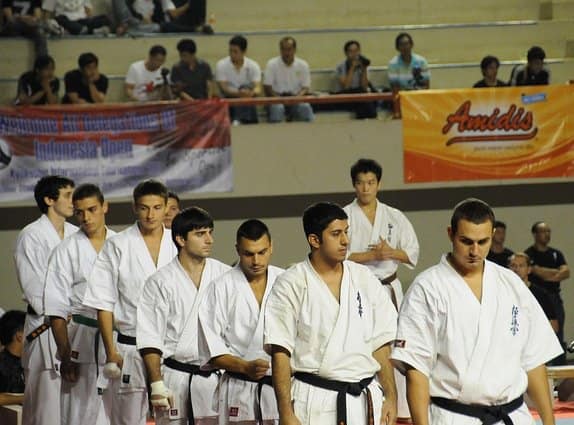
Yes — as a specialist striking foundation.
No — if by “base” you mean complete MMA preparation.
Kyokushin can develop low kicks, varied kicking, body striking, distance, pressure, contact familiarity, conditioning and competition experience. It will not teach you conventional head-punch defence, wrestling, takedown defence, BJJ, cage work, ground-and-pound or the transitions that connect those ranges.
If your immediate objective is to compete in MMA as directly as possible, train MMA.
If your question is different — can Kyokushin give me serious specialist tools that remain useful when I later add MMA-specific training? — the answer is also yes.
Kyokushin can be part of the foundation. It is not the whole building.
The Short Answer
The useful way to think about Kyokushin for MMA is not “does karate work?”
That question is too broad. Different karate systems train under different rules, and MMA is not a collection of isolated techniques.
The better question is: what does Kyokushin make you good at, and what changes when those skills enter MMA?
Kyokushin can contribute
MMA still requires
Wrestling and takedown defence
Body punching and body-kick combinations
Grappling and submissions
Cage or wall work
Ground-and-pound
Transitions between striking and grappling
MMA-specific tactical integration
A specialist art gives you depth. MMA asks whether you can adapt that depth while other ranges are being threatened.
Transfer is not equivalence.
What MMA Actually Requires
MMA is an integrated combat sport. Under the Association of Boxing Commissions’ current Unified Rules framework, MMA has its own competitive rules and judging criteria rather than treating striking and grappling as separate sports performed one after another.
That changes technical decisions everywhere.
A kick is not just a kick when the opponent can level-change underneath it. A punching stance has to account for takedowns. A clinch can become a throw, a wall exchange or a route to the floor. On the ground, positional decisions change when strikes are present.
Knowing Boxing and BJJ separately does not automatically teach you to strike under takedown threat, wrestle against a wall or grapple while strikes are present.
Separate skills give you tools. MMA teaches you when and how to connect them.
That distinction is useful beyond MMA. Kudo, for example, also builds integration into its own ruleset rather than assuming separate striking and grappling skills will connect themselves.
For MMA, the point is simple: a Kyokushin practitioner brings a specialist skill set into a different competitive problem.
Some of it transfers well. Some of it has to change. Some of it is missing completely.
What Kyokushin Can Give You for MMA
Kyokushin’s value for MMA is not a vague claim about toughness.
Its real value is the depth produced by years spent solving a particular full-contact striking problem: kicking, body punching, distance, contact, pressure, technical repetition and competition under knockdown rules.
Not every Kyokushin practitioner develops those qualities equally. Coaching, training partners, competition experience and the individual matter.
But the rules create strong incentives.
Low kicks
Low kicks are one of the clearest areas of transfer.
In Kyokushin kumite, the legs are not an occasional target. Low kicks are part of the standing exchange, and practitioners spend substantial time learning to deliver them, receive them, combine around them and continue working when both people are trying to impose their own attack.
That experience can be useful in MMA, but the context changes. Head punches alter distance and guard; takedowns alter stance and commitment; cage position changes space and counters.
The weapon may transfer. The context changes.
That is the correct way to think about most crossover skills.
Kicking variety
Kyokushin can also produce a broader kicking vocabulary than people who only know it from short knockdown clips may expect.
Round kicks can attack the leg, body or head. Front kicks, knees, side kicks, back kicks and spinning attacks all exist within the wider technical vocabulary, although individual schools and fighters will emphasise different tools.
Not every unusual kick becomes a high-percentage MMA technique. The value is years spent developing balance, timing, range and power from multiple kicking lines — tools that still require adaptation.
A spinning attack becomes more expensive when the opponent can attack the hips or take the back. A high kick needs different preparation when punches to the head are constantly in play.
Body striking and bare-knuckle mechanics
Body punching is central to standard knockdown Kyokushin competition.
That creates comfort attacking the torso at close range, combining punches with low kicks and body kicks, and continuing to work when the exchange becomes crowded.
In kumite, these qualities are not trained one at a time. A low kick can arrive while you are trying to punch the body. A body shot can change your posture while you are preparing to kick. The distance closes, the exchange gets crowded, and technique has to keep working while somebody is actively trying to disrupt it.
Bare-knuckle body punching makes fist position, wrist alignment and impact structure unforgiving.
That does not mean Kyokushin punching transfers unchanged into MMA. MMA gloves alter the hand, guard and target environment, and punches to the head fundamentally change the exchange.
It means a Kyokushin practitioner may arrive with years of experience making body strikes work against resistance rather than only hitting pads.
Useful.
Pressure and contact familiarity
Kyokushin can make repeated legal body and leg contact familiar.
You learn what it feels like when somebody is still attacking after your clean shot. You learn to continue making decisions while tired, after absorbing a body punch or low kick, and while an opponent is trying to take your space.
That familiarity should not be romanticised.
Being comfortable getting hit is not the same as being good at not getting hit.
Contact experience can reduce the novelty of body and leg impact. It does not teach defence against attacks your ruleset does not regularly present.
This becomes especially important when the target moves to the head.
Conditioning, repetition and competition
Kyokushin training can be physically demanding, but “hard” only matters when the work develops something.
Repeated kihon, partner drills, kumite and competition preparation create technical repetition and require execution under fatigue. Competition adds the pressure of performing under rules against somebody trying to win.
That experience can transfer as competition experience. It does not transfer as identical MMA preparation because the legal techniques, ranges and tactical priorities change.
Kata also remains part of Kyokushin’s traditional curriculum and long-term technical structure. It should not be treated as direct MMA preparation. It belongs to the art for its own reasons.
The Biggest Striking Gap: Punches to the Head
This is the limitation that should never be hidden.
Under standard knockdown Kyokushin competition rules, hand and elbow attacks to the opponent’s face or neck are prohibited. WKO Shinkyokushin’s published world-championship rules reflect that standard competitive structure.
That matters enormously for MMA.
A Kyokushin practitioner can become comfortable with body contact, technically strong with kicks and dangerous to the legs and torso without developing the same habits needed to defend a jab, cross or hook combination aimed at the head.
A Kyokushin fighter may be comfortable being hit. That does not automatically make them comfortable defending a jab.
Head punches change posture, vision, guard, entries, exits, combinations and the amount of time available to kick. Smaller MMA gloves change the defensive problem again.
A Kyokushin practitioner moving toward MMA therefore needs genuine work on conventional head-punch offence and defence. That may come through boxing, MMA striking or another programme that teaches those skills properly.
The answer is not “just add a few boxing drills.” The rules created a real technical gap, and that gap needs serious training.
What Else Kyokushin Does Not Teach
The missing pieces are not embarrassing.
They are outside the competitive problem Kyokushin is designed to solve.
Every specialist art has boundaries.
Wrestling and takedown defence
Kyokushin does not make you a wrestler.
A future MMA fighter needs to deal with takedown entries, defence, body locks, scrambles, chain wrestling and the effect of wrestling threats on striking. Depending on the programme and rules, wall or cage wrestling becomes another distinct layer.
Occasional sweeps or off-balancing drills in karate are not equivalent.
A few takedown drills do not create a wrestler.
BJJ and submission grappling
Kyokushin also does not produce extended positional groundwork, guard work, submission offence, submission defence or the escape systems expected in modern grappling.
If you want those skills, train them under qualified grappling coaching.
But the MMA problem goes further than “add BJJ.” Grappling changes when strikes are legal, and takedowns change when the athlete started the exchange at punching range.
Cage or wall work
The wall changes posture, foot position, takedowns, clinch decisions, escapes and the way a fighter gets back to their feet.
Standard Kyokushin competition has no equivalent environment.
That is one of the reasons an athlete cannot recreate MMA preparation simply by accumulating specialist arts outside an MMA room.
Ground-and-pound and transitions
Ground-and-pound is its own skill problem.
A fighter has to create space to strike without surrendering position, defend strikes while grappling, decide when a strike helps a pass or escape, and manage submission threats while striking remains possible.
Then there are the transitions: strike to takedown, takedown to ground control, failed shot to clinch, ground scramble to wall, get-up to striking.
This is where the phrase “well rounded” often becomes too vague.
The issue is not whether you know techniques in several categories. It is whether you can connect them under one competitive ruleset.
Rules Create Skills — and Habits
A ruleset is a training filter.
It rewards some behaviours repeatedly and gives less attention to others. Over time, those incentives shape timing, stance, defence and decision-making.
A boxer must account for kicks and takedowns. A BJJ practitioner must grapple under strikes. A wrestler must respect submissions. A Muay Thai practitioner must adapt parts of stance and clinch work to wrestling.
Kyokushin is not uniquely “incomplete.”
It is specialised.
The same rules that can develop strong low kicking, body striking and comfort in sustained knockdown exchanges do not demand conventional head-punch defence or takedown awareness.
Every specialist brings strengths and rule-created habits. MMA requires integration.
That includes stance.
There is no single universal “Kyokushin stance,” and the lazy claim that all Kyokushin fighters simply keep their hands low is not technically serious. Practitioners, schools and tactics vary.
The more useful point is this:
The rules change what the guard and stance have to solve.
When head punches, level changes and cage pressure become legal, posture and defence have to answer new questions.
Is Muay Thai a Better Base for MMA?
For several conventional MMA striking requirements, Muay Thai maps more directly.
Head punches, kicks, knees, clinch work and defence against punches to the head are already part of its competitive environment. A Muay Thai practitioner may therefore need fewer rule-based changes in some areas of stand-up striking.
That is a real advantage.
Muay Thai still does not automatically provide wrestling, BJJ, cage integration, ground-and-pound or MMA transitions. It remains a specialist striking art, even though its striking rules overlap with MMA more broadly in some areas.
If you are deciding between the striking systems themselves, see our guide to Kyokushin vs Muay Thai vs kickboxing in Auckland.
Do you want the shortest striking route into MMA?
Or do you genuinely want to study Kyokushin as a martial art and carry what you build into MMA later?
Different goals.
Should You Train Kyokushin Before MMA?
Only if you actually want to learn Kyokushin.
Do not treat it as a box to tick before the “real” training starts.
Do not train Kyokushin as a three-month prerequisite for MMA. Train it because you actually want to learn Kyokushin.
Kyokushin has its own curriculum, grading, kata, etiquette, knockdown competition and long-term technical progression. It is worth studying on its own terms.
If somebody trains it seriously for years, they may eventually bring a distinctive kicking game, low-kick experience, body striking, competition experience and particular timing habits into MMA.
That is specialist depth.
Six weeks of collecting techniques is not.
A specialist base is valuable because it is deep, not because it is quick.
For some people, that is exactly the attraction: a serious striking art with its own identity that can later be adapted when their goals broaden.
Kyokushin Fighters Who Successfully Crossed Into MMA
Three documented examples show three different versions of the same principle: a Kyokushin background can matter, but successful MMA requires substantial development beyond Kyokushin.
Georges St-Pierre: foundation plus relentless expansion
UFC documentation says Georges St-Pierre began Kyokushin at age seven and earned a black belt before expanding his MMA training into Brazilian Jiu-Jitsu, wrestling, boxing and Muay Thai. UFC later inducted him into its Hall of Fame.
The lesson is not that Kyokushin made St-Pierre complete.
It is almost the opposite.
His career is evidence that a Kyokushin foundation can coexist with the relentless addition of everything Kyokushin does not give you.
That is exactly what an MMA transition requires.
Katsunori Kikuno: rules created kicking depth
Katsunori Kikuno gives us an unusually useful first-hand example.
In a UFC interview, Kikuno said he trained Kyokushin from age 18 to 23 and linked the absence of hand strikes to the head with the development of his kicking. He also described later studying timing, distance and angles as his MMA experience changed the risk around using those kicks.
Rules helped create a specialist weapon. A new ruleset forced adaptation.
Nikita Krylov: striking background plus submission skill
UFC’s current profile for Nikita Krylov lists Master of Sports credentials in Kyokushin karate and in submission fighting, as well as an ADCC Ukraine title.
His MMA record includes both knockout and submission victories.
Again, the useful point is not “Kyokushin equals MMA.”
It is that the Kyokushin base did not remain isolated. Grappling skill and broader MMA training became part of the athlete.
Different foundation. Much larger finished game.
Does Kyokushin + BJJ Equal MMA?
No.
It can give you a striking specialisation and a grappling specialisation. That can be an excellent combination of skills.
It still does not automatically give you wrestling, cage work, ground-and-pound, takedown integration or the ability to move between striking and grappling while both threats exist at once.
Two specialisations do not magically create an integrated sport.
That does not make either specialisation less valuable.
It means integration has to be trained.
Who Should Use Kyokushin as a Striking Foundation?
Kyokushin makes the most sense in this context for somebody who genuinely wants the art itself.
You may be a strong fit if you want:
full-contact knockdown striking;
serious low-kick and kicking development;
body punching and sustained standing pressure;
a traditional martial-art structure with kihon, kata, grading and etiquette;
competition opportunities inside the Kyokushin ruleset;
a specialist striking identity you are prepared to adapt later;
long-term development rather than a temporary MMA prerequisite.
You do not need previous martial-arts experience to start.
You also do not need to get fit before you begin. Training is where the work starts.
The important filter is willingness to learn, accept correction and train consistently.
Who Should Go Straight to MMA?
The clearest case is the person whose near-term objective is specifically MMA competition.
If you want cage or ring transitions, wrestling under strikes, ground-and-pound and an integrated MMA game as efficiently as possible, those things need to be trained in an MMA environment.
That is simply choosing training that matches the immediate goal. Wanting MMA later does not make a specialist martial art obsolete; it means understanding what must change when the goal changes.
Building a Striking Foundation in Auckland
Auckland City Kyokushin teaches full-contact Kyokushin in the Auckland CBD.
We do not teach MMA, wrestling or BJJ. We do not present Kyokushin as an MMA feeder programme, and we do not pretend it prepares a student for every range.
What we do teach is Kyokushin properly: bare-knuckle body striking, low kicks, varied kicking, kihon, kata, partner work, conditioning and controlled knockdown sparring inside a traditional martial-art structure.
ACK currently trains across the Ellen Melville Centre and HIYOGA Studio in central Auckland, with all levels welcome. Check the main training page for current times because operational details can change.
If MMA interests you but you want to build a striking art with its own depth first, come experience Kyokushin on its own terms.
Then, if your goal later becomes MMA, bring the useful parts with you — and train the missing parts properly.
Is Kyokushin good for MMA?
Yes, as a specialist striking foundation. Low kicks, varied kicking, body striking, pressure and competition experience can transfer, but head-punch adaptation, wrestling, grappling, cage work, ground-and-pound and MMA transitions still have to be trained.
What Kyokushin techniques work in MMA?
Low kicks, body and head kicks, front kicks, knees and some less conventional attacks can have MMA applications. The technique may remain familiar while timing, stance, defence and tactical context change.
Does Kyokushin teach punches to the head?
Not in standard knockdown competition. Hand and elbow attacks to the opponent’s face or neck are prohibited under standard WKO knockdown rules. A practitioner moving into MMA therefore needs dedicated conventional head-punch offence and defence.
Is Muay Thai better than Kyokushin for MMA?
Not universally. Muay Thai maps more directly onto several conventional MMA striking requirements because head punches, kicks, knees and clinch work are already part of its rules. Kyokushin offers a different specialist striking problem and traditional progression.
Do I need Boxing if I train Kyokushin for MMA?
You need to develop conventional head-punch offence and defence somewhere. Boxing is one strong specialist route, but MMA-specific striking coaching can also develop those skills in the context of takedowns and smaller gloves. There is no single mandatory sequence.
Do I need BJJ if I train Kyokushin for MMA?
MMA requires real grappling ability, but BJJ alone is not the entire MMA grappling problem. Wrestling, takedown defence, wall work, grappling under strikes and range transitions also matter.
Does Kyokushin plus BJJ equal MMA?
No. The combination can give you substantial specialist striking and grappling skills, but MMA-specific integration still has to be learned.
Should I train Kyokushin before MMA?
Only if you genuinely want to study Kyokushin. If MMA competition is your immediate objective, direct MMA training is the more direct route. If you want Kyokushin as a serious striking art and may add MMA later, that is a legitimate pathway.
Which UFC fighters have Kyokushin backgrounds?
Strong documented examples include Georges St-Pierre, Katsunori Kikuno and Nikita Krylov. Their careers are useful because each also developed substantial skills outside Kyokushin rather than relying on Kyokushin alone.
Can I train Kyokushin and MMA at the same time?
Potentially. The practical issues are total training load, recovery, time, technical priorities and competition schedules. A serious athlete should coordinate those demands with qualified coaches rather than copying a generic weekly plan.
Can a beginner start Kyokushin if MMA interests them?
Yes. Previous experience is not required. If the striking side of fighting is what interests you and you want a serious specialist art, Kyokushin can be a legitimate place to begin.
Does Auckland City Kyokushin teach MMA?
No. Auckland City Kyokushin teaches Kyokushin. ACK does not teach MMA, wrestling or BJJ.
Build Your Striking Foundation
Kyokushin is not MMA.
That is not a weakness to disguise. It is the reason the training can go deep into its own problem.
If low kicks, varied kicking, body striking, knockdown kumite, traditional progression and serious long-term striking development sound like something you genuinely want to learn, experience it properly.
We teach Kyokushin in the Auckland CBD.
We teach the striking side properly.