
Kyokushin vs Muay Thai vs Kickboxing: Which Is Right for You?
You’re probably looking at Muay Thai or kickboxing because you want real striking.
Fair.
Both can give you that.
But Auckland has another full-contact striking option that many people still associate with point fighting or children’s karate.
Kyokushin is neither.
It is a Japanese full-contact karate system built around kihon, kata, grading and dojo practice alongside knockdown kumite: hard body striking, low kicks, varied kicking and sustained contact. Standard Shinkyokushin competition does not allow hand or elbow attacks to the face or neck. That limitation matters, and we will deal with it directly.
Muay Thai, kickboxing and Kyokushin are all legitimate striking systems. They simply train different competitive problems.
Choose Muay Thai if you specifically want punches, kicks, knees, elbows and extensive clinch work under Muay Thai rules.
Choose kickboxing if punch-kick ring fighting appeals to you and the particular ruleset — K-1, low kick, full contact or another format — matches what you want to compete in.
Choose Kyokushin if you want full-contact knockdown striking, strong body and leg contact, substantial kicking depth and conditioning, but also want grading, kata, dojo etiquette and long-term traditional martial-art progression in the same system.
None of those statements makes one art universally superior.
No hype. No politics. Just the reality.
Forget the question, “Which martial art is toughest?”
It does not help much.
A better question is:
What are you actually trying to become good at?
Do you want to exchange punches to the head? Work extensively in the clinch? Use elbows? Build punch-kick combinations for a ring ruleset? Fight knockdown kumite? Develop a broad kicking vocabulary? Train bare-knuckle body striking? Work through grades and kata as well as sparring?
Those choices matter because rules shape behaviour.
Rules create skills. Rules also create blind spots.
A system becomes good at what it repeatedly asks its practitioners to solve under resistance. Remove or restrict a technique and different habits develop. Add another range and a different problem appears.
That is why Muay Thai, kickboxing and Kyokushin should not be treated as three versions of the same thing.
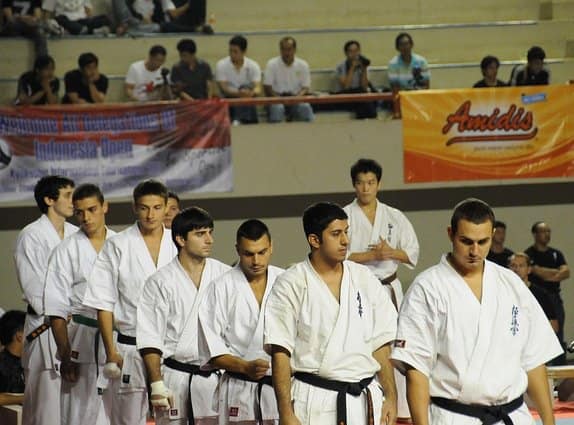
Kyokushin is a full-contact karate system founded by Masutatsu Oyama. Its curriculum combines traditional karate practice — fundamentals, kata, grading and dojo etiquette — with full-contact knockdown kumite. WKO Shinkyokushinkai describes itself as inheriting the Kyokushin tradition founded by Oyama.
In standard knockdown competition, practitioners can attack the body and legs with substantial contact and kick to the head under the applicable rules. Current Shinkyokushin rules prohibit hand and elbow attacks to the face and neck, along with grabbing, hooking around the head or neck, pushing and holding.
That ruleset creates a distinctive rhythm.
There is sustained body punching. Low kicks are a major part of the competitive problem. Kicks can attack different heights and lines. Fighters have to continue functioning while the body and legs are being hit.
Outside competition, Kyokushin is broader than kumite alone. Kihon builds repeated technical fundamentals. Kata preserves structured sequences and technical principles. Grading creates visible long-term progression.
That combination matters.
Someone can find serious striking elsewhere. Someone can find traditional martial-art progression elsewhere.
Kyokushin’s attraction is that the two identities coexist.
Under current IFMA full-contact rules, a scoring Muay Thai skill is a punch, kick, knee or elbow. The rules allow strikes to scoring targets across the body while applying additional head-strike restrictions in younger divisions.
The competitive system develops more than a list of techniques. Balance matters. Timing matters. Rhythm, defence and ring craft matter. Clinch positioning and the ability to strike effectively from close range are substantial parts of Muay Thai practice.
If you specifically want to become a Muay Thai fighter, that is a strong reason to train Muay Thai.
Kyokushin asks you to solve a different striking problem.
Kickboxing is not one universal ruleset.
That distinction is essential.
WAKO, one of the major international governing bodies for kickboxing, currently runs three different ring disciplines: Full Contact, Low Kick and K-1 Rules. Its current rules page also includes 2026 amendments, including changes specific to K-1 Style.
Those formats do not create identical fighters.
Low Kick permits a different target structure from traditional Full Contact. K-1 Rules introduces its own combination of punches, kicks and knees. Different promotions and gyms can introduce further variation.
So if a gym advertises “kickboxing,” ask a useful question:
What rules do you actually train for?
A serious competition-oriented kickboxing gym may develop excellent boxing combinations, ring movement, kicking and tactical skill. A recreational fitness-kickboxing programme may use some of the same movements for an entirely different purpose.
The label alone does not tell you enough.
Muay Thai and kickboxing overlap heavily, but they are not interchangeable.
Muay Thai has its own technical, competitive and cultural tradition. Punches, kicks, knees and elbows are part of its full-contact rule structure, and clinch work is a significant technical range. Current IFMA rules explicitly recognise punches, kicks, knees and elbows as Muay Thai scoring skills.
Kickboxing covers several competitive formats. A K-1-style bout creates a different problem from WAKO Full Contact, and both differ from Muay Thai. WAKO itself separates Full Contact, Low Kick and K-1 Rules rather than treating “kickboxing” as one identical sport.
Depending on the format, kickboxing can place greater emphasis on punch-kick combinations, boxing-led entries, ring movement and rapid combination work while reducing or removing some of Muay Thai’s clinch and elbow game.
That does not make kickboxing “Muay Thai without elbows.”
It means the rules reward different solutions.
And Kyokushin creates a third striking problem again.
Yes.
There is no reason to hide it.
Current Shinkyokushin rules list hand and elbow attacks to the face and neck as fouls. They also prohibit grabbing, hooking around the head or neck, pushing and holding.
That means standard knockdown Kyokushin does not give you the same competitive experience of defending a jab, reading boxing combinations aimed at your head, moving your head under punching threat or building legal hand combinations to the face.
If those skills are your primary objective, that matters substantially.
A Kyokushin practitioner can become very comfortable under body contact.
That does not automatically make them comfortable defending a jab.
The mistake is to pretend the limitation disappears because Kyokushin is physically demanding.
It does not.
The more interesting question is what happens when a ruleset removes head punches with the hands but keeps full-contact body striking and kicking.

Take away hand strikes to the head and the competitive incentives change.
Body punching becomes unusually central. Fighters can work at close range without the same boxing threat to the face, creating sustained exchanges to the torso mixed with kicks and knees.
Bare-knuckle body punching also changes the physical feedback of the strike. Wrist alignment, fist position and impact structure are unforgiving. Poor mechanics tend to reveal themselves quickly.
That does not mean gloves are “fake” or that gloved fighters can hide bad technique. Gloves change hand protection, guard structures, defensive habits, punching volume and impact dynamics.
Different equipment creates different behaviour.
Low kicking is another major part of the Kyokushin problem. Muay Thai and low-kick/K-1 kickboxing can also develop excellent low kicks, so there is no credible reason to award Kyokushin a fictional trophy for them.
The difference is context.
A Kyokushin low kick is being used in a ruleset without legal hand combinations to the head or an extended Muay Thai clinch. That changes stance, distance, combination choices, defensive reactions and the opportunities available after the kick.
Kicking more broadly is one reason people who dismissed karate sometimes find Kyokushin unexpectedly interesting. Low round kicks, body and head kicks, front kicks, side kicks, back kicks and spinning attacks can all appear within the wider technical vocabulary.
Then there is the traditional structure.
Kumite does not replace kihon, kata or grading. The fighting is part of the martial art rather than the entirety of it.
Traditional does not have to mean theoretical.
This table is a decision aid, not a claim that every gym trains identically. Muay Thai details below use current IFMA full-contact rules; kickboxing varies by discipline; Kyokushin refers to standard Shinkyokushin knockdown competition.
Feature
Kyokushin
Muay Thai
Kickboxing
Hand punches to the head
No
Yes, subject to age/division rules
Yes
Body punches
Yes
Yes
Yes
Low kicks
Yes
Yes
Ruleset-dependent; central in Low Kick and K-1
Head kicks
Yes, subject to division/event safety rules
Yes, subject to age/division rules
Yes, subject to age/division rules
Knees
Permitted to legal targets under relevant knockdown rules
Yes
Ruleset-dependent; K-1 includes knees
Elbows
Permitted to legal targets; face/neck elbow attacks prohibited
Yes, with age-specific restrictions
Generally not part of WAKO ring striking
Extended Clinch
No; grabbing, holding and related actions are prohibited
Major technical range
Ruleset-dependent; K-1 is much more limited
Boxing Gloves
Standard adult knockdown is fought bareknuckle; protective equipment varies by division/event
Yes
Yes in WAKO ring disciplines
Kata / grading
Core parts of the wider art
Not central to the sport competition format
Not central to the sport competition format
Typical competition format
Knockdown karate
Ring competition
Ruleset-specific ring competition
The table shows why “Which one has more techniques?” is not particularly useful.
Techniques exist inside rules.
Rules determine which skills get repeated under pressure.
There is no universal answer.
Muay Thai develops kicking inside a system that also contains conventional head punching, elbows and extensive clinch work. A kick has to make sense while those threats and opportunities exist.
Low-kick and K-1 kickboxing create their own combination structures and ring habits.
Kyokushin gives kicking a large amount of competitive space because of what its rules remove and retain. Repeated leg and body contact, close-range exchanges and a broad karate kicking vocabulary make kicking a major part of the art’s technical identity.
For somebody who is particularly attracted to kicking, that deserves serious consideration.
But “best kicks” is still the wrong question.
Ask which kicking problem you want to spend years solving.
It depends on the gym, the coach, the session and what kind of difficulty you mean.
A hard Muay Thai session can involve demanding pad rounds, clinch work, sparring and fight preparation. A serious kickboxing session can put you through high-output combinations, bag work, partner drills, sparring and ring conditioning.
Kyokushin can involve high-volume fundamentals, sustained body and leg contact, repeated kicking, conditioning and knockdown rounds.
All three can be extremely demanding.
One serious gym in the supposedly “easier” art can train much harder than a recreational gym carrying the supposedly “tougher” label.
There is no credible toughness leaderboard.
Hard training is useful when it develops skill, conditioning, composure and the ability to execute technique under pressure.
Random suffering proves much less.
All three can be excellent places to begin when the coaching is good.
Beginner friendliness is not determined by the logo on the wall. It depends on how fundamentals are taught, how contact is introduced, how partners are matched and whether the training culture understands progression.
No combat sport is risk-free. Serious coaching manages risk through appropriate partners, supervision, progressive contact and intensity suited to the student and the purpose of the session.
At Auckland City Kyokushin, all levels are welcome, and controlled knockdown sparring is part of the training.
You do not need to get fit before you begin.
And you do not need to arrive tough.
You need to be willing to train.
Choose the competition problem you actually want.
If you want Muay Thai competition, train a system that prepares you for Muay Thai rules.
If you are drawn to K-1, Low Kick or another kickboxing format, find out whether the gym genuinely trains and competes under that format.
Kyokushin competition gives you a different test: full-contact knockdown kumite inside a wider martial-art structure where competition and grading can coexist.
Competition is not the only reason to train Kyokushin, and it should not be treated as compulsory for every student.
But for somebody who wants to test their striking under pressure, it is a real pathway.
Muay Thai maps more directly onto several obvious MMA striking requirements because it includes conventional head punching, kicks, knees and clinch work.
That still does not make Muay Thai identical to MMA. MMA adds takedown threats, wrestling, cage or wall work, ground-and-pound, grappling under strikes and transitions between ranges.
Kyokushin can contribute kicking, body striking, conditioning, distance habits and experience continuing to work under contact. It still leaves important gaps in conventional head-punch defence, wrestling, grappling and MMA-specific integration.
Transfer is not equivalence.
If MMA is your real goal, our guide to what Kyokushin transfers into MMA — and what it doesn’t looks at that question in detail.

There is a useful historical reason K-1 fans sometimes recognise Kyokushin names.
Andy Hug finished second at the 1987 Fourth World Karate Championship in Kyokushin. He later competed from a Seidokaikan background in K-1 and won the 1996 K-1 World Grand Prix.
Francisco Filho’s K-1 profile lists his club as Kyokushin Kaikan and records major achievements in both systems, including winning the 1999 Kyokushin World Tournament and the K-1 World Grand Prix 2000 in Yokohama, followed by a K-1 World Grand Prix final appearance in 2001.
The lesson is not that Kyokushin and K-1 are equivalent.
They are not.
Those fighters had to adapt to a ruleset where head punching and different combination structures mattered.
Their careers demonstrate something more defensible: a deep Kyokushin striking background can transfer meaningfully into elite kickboxing, but transfer requires adaptation.
Muay Thai has the clearest case if you specifically want extensive clinch work, elbows, conventional head-punch competition and a Muay Thai competitive pathway.
If that ruleset is what excites you, train Muay Thai.
Kickboxing may fit you particularly well if you want punch-kick ring combinations and a specific competition format such as K-1 or Low Kick.
The important step is to investigate the actual gym.
“Kickboxing” by itself tells you less than many beginners assume.
Kyokushin becomes particularly compelling if you want serious striking but do not want the martial-art side stripped away from the experience.
You want low kicks and body contact.
You want kumite and conditioning.
You want a substantial kicking game.
But you also want fundamentals repeated over years, grades that have to be earned, kata, etiquette, a dojo identity and a curriculum that extends beyond preparation for the next bout.
That combination is difficult to reduce to either “traditional karate” or “combat sport.”
It sits across both categories.
Kyokushin is probably the wrong choice if your primary objective is boxing-heavy head-punch competition, extensive Muay Thai clinch and elbow work, immediate MMA integration, no-contact training or a cardio class built mainly around fitness.
For the right person, though, the trade-off is exactly the attraction.
Full-contact knockdown striking inside a traditional martial art.
Auckland already has legitimate Muay Thai and kickboxing options.
Good.
The real question is whether Kyokushin belongs on your shortlist too.
Auckland City Kyokushin trains in Auckland CBD at the Ellen Melville Centre and HIYOGA Studio. We teach full-contact Kyokushin for adults, teens and committed younger students from age seven, with kihon, kata, partner drills and controlled knockdown sparring. ACK is a WKO Shinkyokushin affiliate.
ACK does not teach Muay Thai.
It does not teach kickboxing.
It teaches Kyokushin.
That distinction matters because the reason to visit is not to receive a disguised version of the art you originally searched for.
It is to find out whether the experience underneath your search was broader than the label.
If what you actually want is full-contact striking, low kicks, body contact, conditioning, competition and technical progression — while still training inside a traditional martial-art structure — Kyokushin deserves to be experienced before you decide.
Try Both. Seriously.
You can understand the rules on paper.
You can understand that hand strikes to the head are absent. You can understand what bare-knuckle body striking, knockdown kumite, kata and grading mean.
But none of that tells you how the room feels.
It cannot tell you whether you respond to the pace, the contact, the repetition or the culture.
Eventually, the comparison has to become physical.
Both are full-contact striking arts, but the rules create major differences. Muay Thai includes conventional head punching, elbows and extensive clinch work. Standard Kyokushin knockdown rules prohibit hand and elbow attacks to the face and neck and prohibit grabbing and holding, which shifts more emphasis toward body striking, kicking and knockdown exchanges.
Not in standard Shinkyokushin knockdown competition. Current rules prohibit hand and elbow attacks to the face and neck.
That means Kyokushin should not be presented as a substitute for competitive head-punch experience.
Better for what?
If you want a particular kickboxing ruleset, train it. If you want full-contact knockdown striking combined with kihon, kata, grading and traditional dojo progression, Kyokushin offers a substantially different proposition.
Yes, provided coaching and contact are introduced appropriately.
You do not need previous experience or high fitness before beginning. A serious beginner programme should teach the real curriculum while adjusting coaching, partner selection and physical load to the student.
There is no useful universal winner. Difficulty varies by gym, coach, session and competitive level, and the two arts impose different physical and technical demands.
Standard adult knockdown competition is generally fought without boxing gloves, which is why bare-knuckle body punching is such a visible feature of the ruleset. Protective equipment can differ by age, division and event, so the applicable competition rules should always be checked.
Yes. Low kicking is a major part of standard knockdown kumite and one of the reasons Kyokushin interests people looking for serious stand-up striking.
Muay Thai maps more directly onto several MMA striking requirements because it already includes head punching, knees, kicks and clinch work. MMA still requires wrestling, takedown defence, grappling under strikes and integrated MMA training.
Kyokushin can provide useful specialist striking attributes, but it does not remove those additional requirements.
No.
WAKO alone separates kickboxing into different competitive disciplines including Full Contact, Low Kick and K-1 Rules. Muay Thai has its own technical, competitive and cultural structure.
Start with the rules and training experience you actually want, then evaluate the real gym or dojo rather than choosing only by style name.
If full-contact striking plus traditional progression sounds like the combination you have been looking for, Kyokushin should be on that shortlist.
You can compare martial arts for months.
Eventually, you need to experience one.
If full-contact striking, low kicks, body contact, conditioning and long-term traditional progression sound like the combination you want, come see what Kyokushin actually feels like.
You do not need to arrive tough.
You need to arrive willing.