Your teenager says they want to box. Or train MMA. Or learn Muay Thai.
Maybe they cannot name the style yet. They just know they want something more serious than another activity they attend once a week and forget about.
Good.
The first question is not, “What is the best martial art?”
It is:
What do they actually want to become good at?
If they want deep punching skill and ring craft, Boxing has a very strong case. If they want broad stand-up striking with punches, kicks, knees, elbows and clinch work, Muay Thai is an obvious option. If grappling is the real attraction, BJJ or Judo may be a better first look. If they specifically want the integrated problem of striking, wrestling and ground fighting, MMA may be the most direct route.
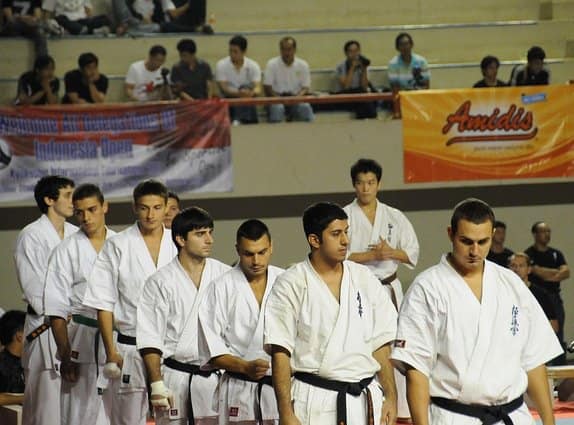
Kyokushin becomes especially interesting for a different teenager: the one who wants full-contact striking, demanding physical training and competition, but also wants traditional martial-art progression, grading, kata, technical repetition and dojo culture.
That combination is unusual.
What Should a Teenager Look for in a Serious Martial Art?

The style matters. The actual gym, club or dojo matters just as much.
A good programme should have clear coaching. Beginners need technical correction rather than being left to copy whoever happens to be standing beside them. Senior students should be expected to control themselves, and the instructor should know what is happening on the floor.
Technique should eventually meet resistance.
In Boxing that may mean sparring. In Muay Thai, sparring and clinch work. In BJJ, rolling. In Judo, randori. In Kyokushin, kumite. In MMA, integrated live training under appropriate constraints.
Pressure-tested does not mean reckless.
The useful question is not whether training looks hard from the outside. It is whether the difficulty develops skill.
Progression matters too. Ask what a teenager who trains consistently for two years will actually become better at. Is there a clear path from beginner fundamentals into more difficult technical work, live resistance and, if they want it, competition?
Then look at culture. Watch how experienced students behave around beginners. Good training partners can work hard without turning every round into a personal contest.
Practicality also matters. A great programme that a teenager cannot reach consistently after school is not much use. Sport New Zealand’s 2025 secondary-school research found that being “too busy” was a major barrier to participation, especially as students got older. Location, timetable and travel are part of the decision, not administrative details.
Best Martial Arts for Teenagers in Auckland

There is no honest overall winner.
Different rules reward different skills. That is the point.
Rules create skills. They also create blind spots.
Boxing
Boxing is a specialist striking sport, and its narrower competitive problem creates remarkable depth.
A good Boxing programme develops punching mechanics, the jab, combinations, footwork, distance, timing, defensive reactions, head movement and ring craft. Those skills are not less valuable because kicks and grappling are excluded. The exclusions allow a boxer to spend an enormous amount of time solving the punching problem.
If your teenager genuinely wants to become a boxer, Boxing is the correct art.
The trade-off is equally clear. Boxing is not designed to develop kicking, clinch knees, throws, submissions or a traditional grading structure. That is not a criticism. It is what specialisation means.
Kyokushin solves a broader striking problem through body punching and a much wider kicking range, but standard knockdown competition does not provide conventional head-punch exchanges with the hands. For a teenager choosing between the two, the question is not which art is tougher. It is which skill set they actually want.
Muay Thai
Muay Thai gives a broad conventional stand-up striking toolkit.
Under the sport’s relevant rules, it can include punches, kicks, knees, elbows and extensive clinch work, alongside balance, timing, rhythm and ring experience. A teenager drawn specifically to that ruleset should train Muay Thai.
That does not make every Muay Thai gym identical. Coaching quality, sparring culture, youth structure and competition pathway still need to be assessed.
For a deeper technical comparison of the striking systems, see compare Muay Thai, kickboxing and Kyokushin in more detail.
Kyokushin is not “better Muay Thai.” It is a different striking problem, with different competitive constraints and a traditional karate structure around the contact work.
Kickboxing for Teenagers
Kickboxing needs one qualification.
There is no single universal kickboxing ruleset.
Some programmes are strongly K-1 influenced. Others use different combinations of punches, kicks, low kicks and knees. Some gyms have serious competitive teams; others use kickboxing primarily as recreational fitness training.
Look past the label.
Ask what rules the gym trains for, how much live sparring is involved and what a teenager can progress into.
For someone interested in punch-kick combinations and ring striking, a strong competitive kickboxing programme can be an excellent fit.
Brazilian Jiu-Jitsu for Teenagers
BJJ solves a completely different problem.
Instead of specialising in striking, Brazilian Jiu-Jitsu develops positional grappling, escapes, control and submissions, usually through large amounts of live rolling.
That makes it particularly attractive to teenagers who enjoy physical problem-solving.
You cannot bluff your way through a resisting opponent trying to pass your guard, escape a position or submit you. Technique has to work against another person making decisions.
For a teenager whose real interest is grappling rather than getting good at punching and kicking, BJJ may be a better answer than Kyokushin.
That is exactly what choosing intelligently looks like.
Kickboxing
“Kickboxing” is not one universal ruleset.
Competitive formats can differ substantially. WAKO, for example, recognises separate ring disciplines including Full Contact, Low Kick and K-1 Rules. A commercial gym may also use the word kickboxing for a recreational fitness class that has little relationship to competitive ring training.
So ask specific questions.
What rules does the gym train for? Does it spar? What techniques are legal? Is there a competition pathway? What happens after the beginner phase?
For a teenager who wants punch-kick ring striking, a serious kickboxing programme can be an excellent fit. The label alone does not tell you enough.
Brazilian Jiu-Jitsu
BJJ solves a different problem from the striking arts.
It develops positional control, escapes, submissions, leverage and live problem-solving on the ground. Rolling matters because a technique that works perfectly on a cooperative partner may fail immediately when the other person is actively trying to escape or reverse the position.
If grappling is the teenager’s real interest, BJJ may be the better answer.
Kyokushin should not be presented as a replacement for that skill set. Occasional clinching or standing contact inside a striking art does not create specialist grappling depth.
Judo
Judo develops gripping, kuzushi, throws, breakfalls, pins, resistant practice and competition inside a traditional Japanese budo structure.
Traditional structure and real resistance are not opposites.
A teenager can learn etiquette, formal progression and technical repetition while also dealing with an opponent who is actively resisting. Judo demonstrates that clearly, and Kyokushin does the same in a different technical domain.
If throwing and grappling are what the teenager wants most, qualified Judo instruction deserves a serious look. Occasional takedown practice inside another martial art is not the same thing as becoming a Judoka.
MMA
MMA is an integrated combat sport.
It is not simply “Boxing plus BJJ.” Striking changes because takedowns exist. Wrestling changes because strikes exist. Ground positioning changes because strikes exist. The transitions between those ranges are skills in themselves.
A teenager does not need to spend years in another martial art before they are allowed to start MMA. If integrated MMA is genuinely the goal and an appropriate youth programme is available, direct MMA training can be the most direct route.
Auckland City Kyokushin does not teach MMA.
That service boundary matters. Kyokushin can develop a serious striking base, but it does not replace wrestling, ground fighting, cage work or MMA-specific integration.
Kyokushin
Kyokushin occupies an unusual position.
It is traditional karate and full-contact knockdown striking at the same time.
Training can include kihon, kata, grading, etiquette and repeated technical fundamentals alongside kumite, body punching, low kicks, varied kicking, conditioning and full-contact competition.
Full-contact striking inside a traditional martial art.
That is the part many teenagers do not realise exists. They assume they have to choose between a traditional martial art with formal progression and a combat sport with real contact.
Kyokushin disrupts that assumption.
There is an important limitation, and it should be stated plainly. Standard knockdown Kyokushin does not provide conventional competitive experience exchanging punches to the head with the hands. Current Shinkyokushin competition rules prohibit hand and elbow attacks to the face and neck.
That matters.
So does what the rules develop instead: sustained body striking, low-kick exchanges, kicking range, physical composure under contact, technical execution while tired and a style of knockdown competition built around a different set of problems.
This is not a claim that Kyokushin is more complete than Boxing, Muay Thai, BJJ, Judo or MMA. It is a claim that the combination is distinctive.
For the teenager who wants serious full-contact striking and also wants grades, kata, etiquette, long-term progression and a dojo identity, Kyokushin can be unusually difficult to replace.
Quick Comparison: Which Martial Art Fits Which Goal?
If the teenager mainly wants…
Strong first option
What to check locally
Deep punching skill and ring craft
Boxing
Coaching quality, sparring progression, youth competition pathway
Broad conventional stand-up striking
Muay Thai
Clinch work, sparring, youth structure, competition rules
Punch-kick ring striking
Kickboxing
Exact ruleset, sparring, whether it is competitive or fitness-focused
Ground grappling and submissions
BJJ
Rolling culture, beginner coaching, competition options
Throws and competitive grappling
Judo
Randori progression, qualified coaching, competition pathway
Integrated striking, wrestling and ground fighting
MMA
Youth-appropriate integrated training and live practice
Full-contact striking with traditional progression
Kyokushin
Kumite progression, partner matching, grading, competition and dojo culture
The table is shorthand. A strong coach in a well-run programme matters more than an internet argument over labels.
Which Martial Art Suits Which Kind of Teenager?
The teenager who loves fighting sports
Ask what part of the sport keeps their attention.
If they are obsessed with hands, Boxing is the obvious specialist route. If they keep watching clinch knees, kicks and stand-up exchanges, Muay Thai may fit. If they are interested in scrambles, takedowns and transitions, MMA becomes more relevant.
If what attracts them is kicking, contact, knockdown exchanges and the idea of progressing through a traditional martial art as well, Kyokushin is worth experiencing rather than dismissing because the word “karate” creates the wrong mental picture.
The teenager who wants hard physical training
Boxing, Muay Thai, MMA, Judo, BJJ and Kyokushin can all be demanding when trained seriously.
There is no useful reason to invent an internet hierarchy of suffering.
Hard training is valuable when it develops something: better technique, better decision-making under pressure, better conditioning for the ruleset or better composure in live work.
Random exhaustion proves very little.
The teenager who loves grappling and technical problem-solving
Start with BJJ or Judo if the teenager is clearly more interested in controlling, throwing, escaping or submitting an opponent than striking.
The right choice is the art that develops the skill they actually want.
The teenager who wants tradition as well as fighting
This is where Kyokushin becomes especially relevant.
Judo also demonstrates that traditional structure can coexist with serious resistance. Kyokushin applies that idea to full-contact striking through kihon, kata, grading, dojo etiquette and kumite.
Traditional does not have to mean theoretical.
The teenager who is tired of team sport
Martial arts are not solitary activities. They still require coaches, training partners and a club or dojo community.
But progress is personal in a way many teenagers find appealing. Nobody else can do the rounds, repetitions, grading preparation or technical work for them.
Your progress is yours.
Is 13, 14, 15 or 16 Too Late to Start Martial Arts?
No.
Starting later means having less accumulated experience today. It does not mean having less potential tomorrow.
Older beginners may be able to understand detailed correction, practise deliberately and take more responsibility for their own progress. None of that guarantees rapid advancement or competition success. It simply means there is no sensible reason to treat the early teenage years as “too late.”
Is 13 too late to start?
No. Thirteen is still an entirely normal age to begin learning a difficult physical skill.
Is 14 too late to start?
No. A fourteen-year-old beginner starts with beginner fundamentals, just like anybody else.
Is 15 too late to start?
No. Fifteen means starting with less experience than someone who began at eight. That is an experience gap, not a verdict on future capability.
Is 16 too late to start?
No. Martial arts can be practised for decades. Sixteen is early in that time frame.
Starting later means less experience today — not less potential tomorrow.
Should Teenagers Train With Adults?
Sometimes, yes.
Mixed-age training can work well when the coaching is responsible. It can expose teenagers to experienced students, higher technical standards and useful mentoring.
But one curriculum does not mean identical physical load.
A thirteen-year-old beginner should not simply be treated as a smaller adult competitor. Partner choice, contact level, drill difficulty and sparring intensity should reflect age, size, experience and the purpose of the session.
At Auckland City Kyokushin, adults, teens and committed younger students train in a mixed-age structure. The principle is straightforward:
Same curriculum. Same fundamentals. Same etiquette. Appropriate partners. Appropriate intensity.
That is what “one dojo” should mean in practice.
What Does “Full Contact” Mean for a Teenager?
No combat sport is completely risk-free.
The useful question is how risk is managed.
Full-contact competition rules do not mean every training round is an uncontrolled fight. Responsible coaching uses progressive exposure, appropriate partner matching, supervised contact and intensity that reflects the student and the purpose of the session.
At ACK, controlled knockdown sparring is part of the training. That word matters: controlled.
Protective equipment and competition restrictions can also vary by age, division, organisation and event. Those details should be checked against the current rules rather than assumed from adult competition.
Suspected concussion or significant injury should be taken seriously. Current New Zealand sport guidance follows a recognise, remove and refer approach for suspected concussion rather than encouraging an athlete to continue.
Serious does not mean reckless.
Do You Need to Be Fit Before Starting?
No.
Fitness is not an entry qualification for martial arts.
A beginner needs enough willingness to show up, listen, work at an appropriate level and keep learning. Conditioning can then be developed through the training process over time.
You do not get fit so you can finally earn permission to begin.
You begin.
Beginner means inexperienced. The standard stays real; the load is coached appropriately.
The standard does not need to be lowered because somebody is new. The coaching starts where they actually are.
Who Should Choose Kyokushin?

Kyokushin deserves a serious look when the teenager wants more than one thing from the same system.
They want striking, but not only hands. They want low kicks and a broad kicking vocabulary. They want kumite and physical pressure. They want technical fundamentals and conditioning.
At the same time, they want formal progression. Grades. Kata. Etiquette. A dojo. A curriculum that can still be demanding years after the first class.
Someone can get excellent striking elsewhere.
Someone can get traditional progression elsewhere.
Kyokushin’s attraction is that those two identities coexist.
For the right teenager, that is not a compromise between “traditional martial arts” and “real contact.” It is the reason to choose the system.
Competition can be part of that pathway for students who want it and are ready for it, but competition is not the only reason to train. The deeper proposition is long-term progression inside a martial art that does not remove contact from the curriculum.
Who Should Not Choose Kyokushin?
Kyokushin is probably not the clearest first choice if the teenager’s primary goal is:
specialist Boxing and conventional head-punch competition
ground grappling and submissions
specialist Judo throwing
immediate integrated MMA competition
a casual, low-commitment activity with little interest in contact or long-term progression
None of it means a Kyokushin beginner needs to arrive tough, fit or experienced.
They need to be willing to train.
Serious Martial Arts for Teenagers in Auckland CBD
Auckland City Kyokushin trains in the Auckland CBD at Ellen Melville Centre and HIYOGA Studio.
ACK welcomes adults, teens and committed younger students from age 7+, including beginners. Students train the same Kyokushin curriculum in a mixed-age structure, with partner choice and intensity adjusted appropriately. Controlled knockdown sparring is part of the training. ACK is a WKO Shinkyokushin affiliate.
Operational details can change, so check the current Auckland City Kyokushin training information before attending.
For a teenager, the practical advantage of a central location is simple: serious training is only useful if they can attend consistently around school, study, family and transport.
The more important question is fit.
Does the teenager want a real curriculum? Are they willing to be corrected? Will they repeat fundamentals? Are they prepared to experience contact progressively and train with people of different experience levels appropriately?
If the answer is yes, they do not need to arrive looking like a martial artist.
That is what the training is for.
What is the best martial art for a teenager?
The best martial art depends on what the teenager wants to become good at. Boxing is excellent for specialist punching, Muay Thai for broad stand-up striking, BJJ for ground grappling, Judo for throws, MMA for integrated fighting and Kyokushin for full-contact striking inside a traditional martial-art structure.
Is 14 too late to start martial arts?
No. Fourteen is not too late. The teenager will have less experience than someone who started younger, but that does not determine their long-term potential.
Is 15 too late to start karate?
No. A fifteen-year-old beginner starts with fundamentals and progresses from there. There is no credible reason to treat fifteen as too late for long-term martial-arts training.
Is 16 too late to start martial arts?
No. Martial arts can be practised for decades. Sixteen is still an early starting point in that context.
Is Kyokushin suitable for teenagers?
It can be a strong fit for a teenager who wants serious striking, traditional progression and a demanding training environment, provided contact, partners and intensity are coached appropriately.
Does Kyokushin have punches to the head?
Not in standard knockdown competition. Current Shinkyokushin rules prohibit hand and elbow attacks to the face and neck. That is a real limitation compared with Boxing, Muay Thai, many kickboxing rulesets and MMA.
Can teenagers train martial arts with adults?
Sometimes. Mixed-age training can work well when partner selection, intensity and coaching are appropriate to age, size, experience and the purpose of the session.
Do teenagers need to be fit before starting martial arts?
No. Fitness is not an entry qualification. A beginner needs willingness, consistency and appropriate effort; physical capacity is developed progressively through training.
Should a teenager choose Boxing, Muay Thai, MMA or Karate?
Choose according to the skill they want. Boxing specialises in hands, Muay Thai in broad stand-up striking, MMA integrates striking and grappling, while a full-contact karate system such as Kyokushin combines knockdown striking with traditional progression.
Can teenagers compete in Kyokushin?
Competition can be available for appropriately prepared students under the current age, division and event rules. Competition should not be presented as mandatory for every student.
Is Kyokushin too hard for a beginner?
Kyokushin can be demanding, but demanding does not have to mean beginner-hostile. Beginners should be introduced progressively, coached from their current level and matched appropriately.
Experience a Real Kyokushin Class
You can compare martial arts for months.
Eventually, you need to experience one.
If full-contact striking, serious standards and traditional progression sound like the combination your teenager has been looking for, come see what Kyokushin actually feels like at Auckland City Kyokushin.
You do not need to arrive tough. You need to arrive willing.