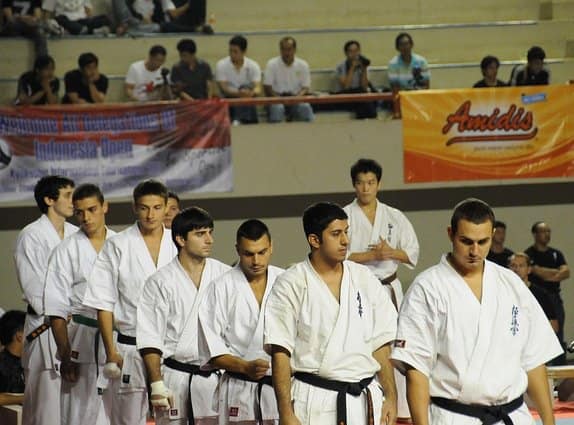
You searched for Muay Thai or kickboxing in Auckland.
We do not teach Muay Thai. We do not teach kickboxing. Auckland City Kyokushin teaches full-contact Kyokushin karate.
But if the reason you are searching is that you want hard striking, low kicks, serious conditioning, sparring, physical pressure and a skill you can keep developing for years, Kyokushin deserves to be part of your decision before you choose where to train.
This is not kickboxing in a karate uniform.
It is a different full-contact striking problem.
What Are You Actually Looking For?
The martial art you type into Google and the training experience you actually want are not always the same thing.
Some people want Muay Thai specifically. They want its rules, elbows, knees, extensive clinch work and competition pathway. Some people want a particular kickboxing ruleset: K-1-style striking, low-kick competition, full-contact kickboxing or another defined format.
If that is you, train the ruleset you actually want.
But many people start with the names they already know. “Muay Thai” or “kickboxing” becomes shorthand for something broader:
I want real stand-up striking.
I want to kick as well as punch.
I want contact and resistance.
I want conditioning that supports the skill.
I want to spar.
I may want to compete.
I want technical progression, not just another workout.
I want a serious training environment.
If that list sounds closer to your real objective, the question changes.
Are you searching for a ruleset — or a training experience?
That is where Kyokushin enters the conversation.
If You Specifically Want Muay Thai, Train Muay Thai
Muay Thai is a complete striking sport with its own technical and cultural tradition. Under modern competition rules it uses punches, kicks, knees and elbows, with clinch work forming a major part of the fighting problem.
If elbows, extensive clinch work and Muay Thai competition are specifically what you want, train Muay Thai.
That is not a weakness in the Kyokushin case. It is simply an honest answer.
If you want the detailed technical differences, see our full Kyokushin vs Muay Thai vs kickboxing comparison.
If You Specifically Want Kickboxing, Train Kickboxing
Kickboxing is not one universal ruleset. Major competition structures distinguish formats including Full Contact, Low Kick and K-1 Style, and individual gyms may train toward different competitive or recreational goals.
If a particular kickboxing ruleset and competition pathway is what excites you, train it.
The useful question for everyone else is whether the word kickboxing is standing in for something more general: punch-kick striking, live resistance, conditioning and a serious place to train.
If it is, you have more than one option.
But If What You Want Is Serious Full-Contact Striking…

Kyokushin is not Muay Thai with fewer techniques. It is not kickboxing in a gi.
It is full-contact knockdown karate built around a different ruleset and a different training structure.
At Auckland City Kyokushin, training is built around kihon, kata, partner drills, bare-knuckle body conditioning and controlled knockdown sparring. Students learn fundamentals, strike under resistance and progressively experience the physical consequences of distance, timing, balance and poor technique.
Body shots are real. Low kicks are trained as fighting techniques. Kumite asks whether technique still works when another person is moving, resisting and striking back.
That matters because training under resistance changes what you notice. A stance that feels stable in solo practice may become slow when somebody pressures you. A kick that looks clean on a pad may leave you badly positioned when the target moves. A combination that works fresh may fall apart when your legs are tired.
Full-contact means the techniques have consequences. Training still has to be controlled.
Kyokushin also gives the striking a long-term structure. You are not only accumulating combinations. You are working through fundamentals, kata, grading, etiquette, kumite and competition under one system.
For some people, that combination is exactly what they thought they had to choose between.
What Makes Kyokushin Different?

A lot of people still carry an old mental model:
Muay Thai or kickboxing means real striking. Karate means light contact, forms or children’s classes.
Kyokushin does not fit that model.
It combines traditional martial-art structure with full-contact striking. Kihon and kata sit beside body punching, low kicks, conditioning and knockdown kumite. Formal progression exists alongside contact. Grading exists alongside competition. Dojo etiquette exists alongside the requirement to make technique work under pressure.
Traditional structure + full-contact striking.
That is the point.
Someone can get excellent striking elsewhere. Someone can get traditional progression elsewhere. Kyokushin becomes distinctive when you want both identities in the same training system.
It is also a long game. The aim is not to survive a few hard classes and collect a story about how tough training was. The aim is to develop technique, conditioning, judgement and composure over years.
Random suffering proves very little.
Hard training is useful when it develops something.
This is the important limitation, and it should not be hidden.
Standard knockdown Kyokushin does not permit hand strikes to the face or neck in competition. That means it does not give you the same competitive experience of exchanging punches to the head that you get in Muay Thai, many kickboxing rulesets or boxing.
That matters.
So does what the Kyokushin ruleset develops instead: sustained body striking, low kicks, varied kicking, body contact, pressure, conditioning and knockdown tactics inside its own competitive problem.
If conventional head-punch offence and defence are a major priority for you, read the full striking-art comparison before deciding.
One ruleset does not make another fake. Rules create skills. They also create blind spots.
The useful question is which problem you want to spend your time learning to solve.
Is Kyokushin Good for Beginners?
Yes — if you are willing to train.
You do not need to arrive fit, tough, coordinated or experienced. Beginners need coaching, repetition and an appropriate introduction to contact, not a watered-down version of the martial art.
At ACK, all levels are welcome. The curriculum remains real, while partner choice, contact and intensity should reflect experience and the purpose of the session.
Beginner means inexperienced. The standard stays real; the load is coached appropriately.
No combat sport is risk-free. Full-contact rules do not mean uncontrolled practice. Controlled sparring, progressive exposure, appropriate partners and supervision matter.
You also do not need to “get fit first.” Fitness is not an entry qualification. You start learning the skill, and the physical demands develop with the training.
The real filter is simpler: are you willing to show up, listen, accept correction, repeat fundamentals and keep training when it becomes uncomfortable?
Full-Contact Kyokushin in Auckland CBD
Auckland City Kyokushin trains in the Auckland CBD across the Ellen Melville Centre and HIYOGA Studio. We welcome adults, teens and committed younger students from age 7+, including complete beginners.
Main Kyokushin training runs on Tuesday and Thursday evenings, with additional invitation-only training for dedicated students. Training includes controlled knockdown sparring, kihon, kata, partner drills, conditioning and tournament preparation. ACK is a WKO Shinkyokushin affiliate.
For somebody who works, studies, lives or regularly travels through central Auckland, location matters because consistency matters. A technically perfect programme on the other side of the city is not useful if you rarely make it to class.
You may have started this search looking for Muay Thai or kickboxing.
If what you really want is a specific Muay Thai or kickboxing ruleset, the answer is straightforward.
If what you want is serious full-contact striking, low kicks, body contact, demanding training and long-term martial-art progression, there is another option in the CBD.
Kyokushin.
Do you teach Muay Thai?
No. Auckland City Kyokushin teaches full-contact Kyokushin karate.
Do you teach kickboxing?
No. ACK teaches Kyokushin. If what attracts you to kickboxing is serious punch-kick striking, contact and technical progression rather than one specific ruleset, Kyokushin may also be worth considering.
Is Kyokushin similar to Muay Thai?
Both are full-contact striking arts, but they solve different competitive problems. Muay Thai includes punches, kicks, knees, elbows and extensive clinch work. Standard knockdown Kyokushin prohibits hand strikes to the face or neck and places different emphasis on body striking, low kicks, varied kicking and knockdown tactics.
Does Kyokushin allow punches to the head?
Not in standard knockdown competition. Hand strikes to the face and neck are prohibited. That is a real limitation if conventional head-punch competition is your priority.
Does Kyokushin have low kicks?
Yes. Low kicks are a central part of Kyokushin knockdown striking and training.
Is Kyokushin full contact?
Standard knockdown competition is full contact. Everyday training should still be coached progressively; full-contact rules do not mean every session is uncontrolled hard sparring.
Can a complete beginner start?
Yes. ACK welcomes all levels. You do not need previous martial-arts experience before applying to train.
Do I need to get fit first?
No. Fitness is not an entry requirement. Start learning the skill and build your capacity through consistent training.
Is Kyokushin worth considering if I was looking for kickboxing?
Potentially. If the attraction is hard striking, kicks, contact, conditioning, sparring and long-term technical progression rather than one specific kickboxing ruleset, Kyokushin is worth experiencing.
Where does Auckland City Kyokushin train?
In the Auckland CBD, across the Ellen Melville Centre and HIYOGA Studio. Training details can change, so check the current timetable before attending.
Experience Full-Contact Kyokushin
You can keep comparing websites.
Eventually, the search has to become physical.
If what you want is hard striking, low kicks, body contact, serious standards and a martial art you can keep progressing in for years, come experience what Kyokushin actually feels like.
You do not need to arrive tough.
You need to be willing to train.