You already know what resistance feels like.
You drill a technique. Then somebody tries to stop it. A movement that looked clean in isolation suddenly has to survive timing, pressure, bad position and a resisting partner.
That is why BJJ gets deep.
If you are adding striking, the first question is not simply, which striking art is best?
It is:
Do you want enough striking to fill a gap — or do you want striking to become a second martial art?
If you want the deepest specialist hands, Boxing has the strongest case.
If you want broad conventional stand-up striking — punches, kicks, knees and extensive clinch work — Muay Thai has an obvious case.
If you want punch-kick ring striking, Kickboxing may fit well, but the exact ruleset matters.
If your real goal is integrated cage fighting, train MMA.
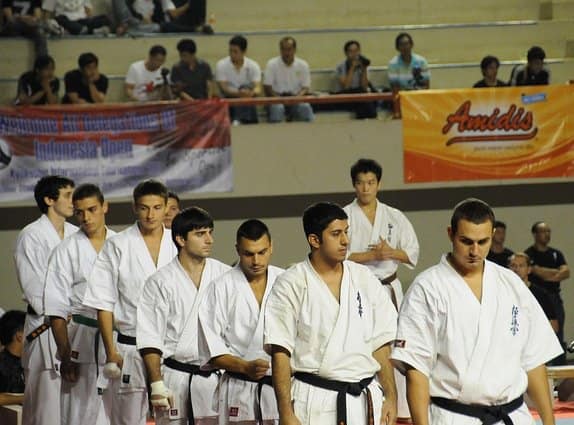
And if you want full-contact striking to become a second deep martial art — with low kicks, varied kicking, body striking, kumite, grading, competition and traditional progression — Kyokushin becomes a different proposition.
There is no universal winner.
What kind of striker do you want to become?
The Short Answer: What Kind of Striker Do You Want to Become?
Your main goal
Strong first option
Main trade-off
Deepest pure punching
Boxing
Connecting ranges under one MMA ruleset
Broad conventional stand-up striking
Muay Thai
Ground control, escapes, submissions, live grappling
Punch-kick ring combinations
Kickboxing
Takedown skill, pressure, positional control
Integrated cage fighting
MMA
Punches, kicks, knees, clinch and ring striking
Full-contact striking as a second deep martial art
Kyokushin
Hands, footwork, timing, defence and ring craft
This is not a toughness ranking.
Rules create skills. Rules also create blind spots.
BJJ develops exceptional grappling depth because it specialises. Boxing develops exceptional hands because it specialises. Muay Thai develops a broad stand-up game because its rules reward one. Kyokushin develops its own striking attributes because its competitive problem is different.
Scope is not the same as quality.
The useful question is which rules, training environment and long-term progression match what you actually want from your second art.
Do You Want Striking Lessons — or a Second Martial Art?
Cross-training can mean two very different things.
The first is supplementation. You already identify as a BJJ practitioner and want enough stand-up skill to stop feeling completely foreign on the feet. One good striking class a week at your existing academy may be exactly what you need.
The second is specialisation.
You want to become competent enough that striking is no longer “the thing you do on Tuesdays after BJJ.” You want a room full of people who care about it deeply, a curriculum that keeps unfolding, live rounds, competition if you choose it, and standards that take years rather than weeks.
A BJJ practitioner should understand that distinction immediately.
You did not become good at guard retention, passing or submissions by collecting a few techniques. You repeated them, failed with them, adjusted them and learned what happens when a better grappler refuses to cooperate.
Striking depth works the same way in one important sense:
knowing techniques is not the same as owning them.
That is where the choice changes.
If your current BJJ academy already has excellent striking coaching that you enjoy, use it. One-roof convenience is real, and for many practitioners it is the sensible answer.
But if you want striking itself to become another art you study seriously, convenience is no longer the only question.
Depth starts to matter.
Boxing for BJJ Practitioners
Boxing has a very strong case if your priority is hands.
A narrow ruleset is not a defect. It is what allows Boxing to spend extraordinary amounts of time on jab mechanics, combination structure, footwork, distance, head movement, defensive reactions, timing and ring craft.
For a BJJ practitioner who specifically wants to understand conventional punching exchanges, that depth is hard to beat.
Boxing does not give you kicks, knees, grappling or takedown integration. But saying “Boxing only has punches” misses the point.
It has an entire sport built around punching.
That produces depth.
If your reason for adding striking is mainly, “I want the strongest direct education in hands and head-punch defence,” Boxing may be the best answer.
Muay Thai for BJJ Practitioners
Muay Thai gives you a broader conventional stand-up problem.
Punches, kicks, knees, elbows and extensive clinch work all matter under its rules. Balance, posture, rhythm and close-range decision-making become part of the same striking system.
A BJJ practitioner may find some of the clinch concepts familiar at a high level: posture matters, balance matters, frames and grips matter, and small positional errors can become expensive.
But Muay Thai clinch is not BJJ standing up.
The goals, scoring, legal attacks, posture and reactions are different. Treat it as its own specialist skill rather than assuming your grappling automatically transfers.
If you want broad conventional stand-up striking, Muay Thai has an excellent case.
For a deeper comparison between the striking systems, see ACK’s guide to Kyokushin, Muay Thai and kickboxing.
Kickboxing for BJJ Practitioners
Kickboxing needs one qualification immediately:
Kickboxing is not one universal ruleset.
The World Association of Kickboxing Organizations distinguishes several competitive disciplines, including the ring formats Full Contact, Low Kick and K-1 Rules. Kickboxing New Zealand currently works alongside WAKO IF rules and regulations.
That matters because “I train kickboxing” can describe different technical environments.
Some programmes place more emphasis on boxing combinations. Some allow low kicks. Some compete under K1-style rules. Some gyms use the term more loosely for general punch-kick training.
For a BJJ practitioner, the practical questions are simple:
Which rules does the gym actually train for?
How much live sparring is there?
Are low kicks central?
How much clinch work exists?
What competition pathway is available?
Is there a clear technical progression beyond pad combinations?
If the answer matches what you want, Kickboxing can be an excellent striking route.
The label alone is not enough.
Kyokushin for BJJ Practitioners
Kyokushin should not be understood as another version of kickboxing.
It is a full-contact traditional martial art.
That distinction matters because a BJJ practitioner is not simply choosing techniques. You are choosing another training culture, another ruleset and potentially another long-term technical identity.
Kyokushin training can include kihon, kata, partner drills, conditioning, kumite, grading, dojo etiquette and competition. In standard knockdown rules, body punching, low kicks, body and head kicks, knees and sustained stand-up contact create a different striking problem from Boxing, Muay Thai or conventional Kickboxing.
For somebody already willing to spend years getting better at grappling, the appeal should be obvious.
You are not adding a few kicks to BJJ.
You are entering another system that expects you to keep refining stance, distance, body mechanics, kicking, timing, contact and decision-making under its own rules.
Kyokushin is not just something to add to BJJ. It can become the second martial art you study seriously.
That does not mean BJJ is incomplete.
It does not mean Kyokushin “fixes” grappling.
It does not mean one combination is tougher than another.
The case is that specialist depth is valuable — and BJJ practitioners already know why.
From Rolling to Kumite
In BJJ, you can drill a sweep perfectly and discover five seconds into rolling that you never really owned it.
The partner changes posture. They remove the grip. They put weight in the wrong place. The timing disappears.
Kumite gives striking its own version of that problem.
Distance moves. The opponent does not stand where you want them. Your kick has to arrive without ruining your balance. Your body shot has to work while somebody is trying to hit or kick you back. Defence and attack stop taking turns.
The technical details are completely different from rolling.
The learning principle is familiar.
Resistance exposes fantasy.
A compliant drill can teach mechanics. Live practice tells you what those mechanics look like when timing and opposition enter the room.
That is why the bridge from BJJ to Kyokushin can make sense psychologically without pretending the arts are technically equivalent.
You already understand the value of a resisting partner.
Kumite gives you a different problem standing.
But What About Punches to the Head?
This is the limitation that matters most for many BJJ practitioners.
Standard knockdown Kyokushin does not permit hand or elbow attacks to the face or neck in competition.
That means it does not give you the same conventional competitive experience with jabs to the head, boxing combinations, head movement and punch defence that you would get from Boxing, Muay Thai or many Kickboxing rulesets.
If head-punch offence and defence are the main reason you are adding striking, Boxing or Muay Thai may have the stronger direct argument.
That limitation matters. So does what Kyokushin develops instead.
Kyokushin develops a different problem: body punching, low kicks, varied kicking, head kicks, knees, close stand-up pressure, repeated legal contact to the body and legs, and knockdown competition.
The limitation matters. So does what the ruleset develops instead.
For a BJJ practitioner choosing a second specialisation, the question is not whether Kyokushin contains every striking skill.
It does not.
The question is whether the striking problem it develops is one you want to spend years solving.
Should You Train BJJ and Striking at the Same Gym?
There are good reasons to keep everything under one roof.
Travel is easier. Timetables are simpler. One membership may cost less than two. You already know the coaches and the culture. If the gym teaches MMA, it may also offer a cleaner path toward integrating striking and grappling.
Those are real advantages.
Auckland makes this particularly relevant because multiple BJJ and combat-sport gyms currently offer striking and grappling within the same organisation.
So why go somewhere else?
Only if the second gym gives you something you actually value enough to justify the inconvenience.
That might be a deeper specialist curriculum, more experienced partners in that art, its own competition pathway, a grading structure, or simply a training culture centred on becoming good at one particular striking problem.
Are you supplementing BJJ — or building a second specialisation?
The answer should decide whether one gym or two makes sense.
Why Pay for Two Memberships?
You probably should not if all you want is basic striking and good coaching is already included at your BJJ academy.
A second membership means more cost, more travel and more demands on the week.
It only makes sense if you genuinely want what the second art offers.
The same applies to time.
If you already train BJJ three or four times a week, adding another serious art can create scheduling pressure. There is no magic weekly split that works for everyone.
A second specialist art is useful only if you can train it consistently enough to improve.
Think in years, not in a twelve-week “become complete” project.
A serious BJJ practitioner already knows that six months is not very long.
Give striking the same respect if you decide it matters.
BJJ + Striking Does Not Automatically Equal MMA
BJJ gives you grappling tools.
A striking art gives you striking tools.
MMA requires more than placing those tools beside each other.
Wrestling, takedown defence, wall or cage work, ground-and-pound, striking under takedown threat, grappling under strikes and transitions between ranges all change the problem.
Two specialisations do not magically create an integrated sport.
If your actual goal is MMA competition or integrated cage fighting, MMA-specific training is usually the more direct answer. Our guide to what Kyokushin transfers into MMA — and what it doesn’t looks at that problem in detail.
That recommendation does not reduce the value of specialist arts. It simply respects what MMA is.
If you are interested in another martial art built around integrating striking, throws and groundwork under one ruleset, ACK’s Kudo in New Zealand guide explains why combining specialist ingredients is not the same as learning an integrated system. Auckland City Kyokushin does not teach Kudo.
Which Striking Art Is Best for Different Goals?
Priority
Strong option
Why
Specialist punching and head-punch defence
Boxing
Maximum technical depth around hands, footwork, distance and defensive reactions
Broad conventional
stand-up striking
Muay Thai
Punches, kicks, knees, elbows and extensive clinch
Punch-kick ring fighting
Kickboxing
Strong fit where the gym’s actual rules and competition pathway match your goals
Integrated striking + wrestling + grappling
MMA
Trains the ranges together rather than as separate specialist arts
Second deep martial art built around full-contact striking
Kyokushin
Kumite, low kicks, kicking depth, body striking, grading, competition and traditional progression
Best always means best for something.
If you know the goal, the choice becomes much easier.
Adding a Second Martial Art in Auckland
Auckland BJJ practitioners already have convenient striking options.
That is not a weakness in the market. It is reality.
If good striking coaching is already available where you train and all you want is supplemental coverage, use it.
Auckland City Kyokushin offers something else.
Auckland City Kyokushin teaches one thing: full-contact Kyokushin.
We do not teach BJJ.
We do not teach MMA.
We do not teach Muay Thai, Boxing or Kickboxing.
What we offer is a dedicated Kyokushin environment in Auckland CBD, with full-contact striking, kihon, kata, partner work, controlled knockdown sparring, grading, conditioning and a long-term dojo structure.
Auckland City Kyokushin trains at the Ellen Melville Centre and HIYOGA Studio in Auckland CBD. Main sessions run on Tuesday and Thursday, with invitation-only Sunday training. Check the ACK homepage before attending because operational details can change.
If you merely want to plug the striking gap in your BJJ game, good coaching where you already train may be enough.
If you want striking itself to become another martial art you are willing to study seriously, Kyokushin is a different proposition.
What is the best striking art to add to BJJ?
It depends on the goal. Boxing is strongest for specialist hands, Muay Thai for broad conventional stand-up striking, Kickboxing for ruleset-specific punch-kick competition, MMA for integrated fighting, and Kyokushin for somebody who wants full-contact striking to become a second deep martial art.
Is Boxing good to combine with BJJ?
Yes. Boxing has a strong case if punching mechanics, footwork, distance, head movement and conventional head-punch defence are your priority.
Is Muay Thai good for BJJ practitioners?
Yes. Muay Thai offers broad stand-up striking through punches, kicks, knees, elbows and extensive clinch work. It remains a specialist striking art rather than MMA integration.
Is Kickboxing good with BJJ?
It can be. The exact answer depends on the ruleset and the quality of coaching. “Kickboxing” can refer to different competitive formats, so ask what the gym actually trains for.
Is Kyokushin good with BJJ?
It can be a strong second specialist art for somebody who wants full-contact striking, low kicks, varied kicking, body striking, kumite, grading and traditional progression.
Does Kyokushin allow punches to the head?
Not in standard knockdown competition. That limitation matters if conventional head-punch offence and defence are your main reason for adding striking.
Is BJJ + Kyokushin good for MMA?
They can provide specialist grappling and striking skills, but they do not automatically create MMA. MMA requires its own wrestling, wall work, ground-and-pound and integration between ranges.
Should I train MMA instead?
If integrated cage fighting or MMA competition is the actual goal, MMA-specific training is usually the more direct route.
Should I train striking at my BJJ gym?
If the coaching is good and you only want supplemental striking, that may be the most practical answer. A second gym makes more sense when you genuinely want a second specialisation.
Why would I train at two gyms?
Only if you value the depth, curriculum, partners, competition or progression of the second art enough to justify the extra time, cost and travel.
Does Auckland City Kyokushin teach BJJ?
No. ACK teaches full-contact Kyokushin.
You Already Know What Resistance Feels Like on the Ground
You know what happens when a technique meets somebody who does not want it to work.
That is why you roll.
Kyokushin gives you a different problem: distance, kicks, body contact, striking pressure and kumite.
If you only want enough striking to fill a gap, good coaching at your existing academy may be all you need.
But if you want striking itself to become a second martial art, come experience Kyokushin.
You already know what resistance feels like on the ground. Come experience it standing.