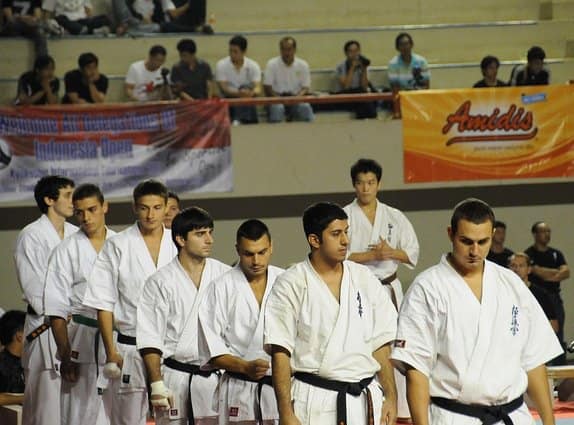
Your teenager says they want to train MMA.
Good.
Take the interest seriously before deciding what the answer should be.
“MMA” can mean several different things to a teenager. They may be obsessed with striking. Or submissions. Or takedowns. They may want to compete. They may simply like the idea of learning how different ranges fit together.
The useful first question is:
What part of MMA actually interests them?
If they want striking, wrestling and ground fighting integrated together, an appropriate youth MMA programme may be the most direct answer.
If they mainly want submissions and ground grappling, BJJ deserves a serious look. If they want takedowns and control, wrestling may fit. If they are drawn to broad stand-up striking, Muay Thai is relevant. If hands are the obsession, Boxing. If throws and gripping appeal, Judo.
And if what keeps catching their attention is kicking, stand-up pressure, body contact, knockdowns, conditioning, competition and serious technical progression, Kyokushin belongs in the conversation.
There is no compulsory martial art a teenager must complete before MMA.
Specialising first is an option.
Not a prerequisite.
The Short Answer
The best first step depends on the training problem your teenager actually wants.
What interests them most?
Strong starting route
What that route develops
Integrated striking + takedowns + grappling
Youth MMA
Connecting ranges under one MMA ruleset
Submissions + positional grappling
BJJ
Ground control, escapes, submissions, live grappling
Takedowns + scrambles + control
Wrestling
Takedown skill, pressure, positional control
Broad stand-up striking
Muay Thai
Punches, kicks, knees, clinch and ring striking
Punching
Boxing
Hands, footwork, timing, defence and ring craft
Throws + gripping
Judo
Gripping, balance breaking, throws and competitive grappling
Full-contact striking + traditional progression
Kyokushin
Kicking, body striking, knockdown kumite, grading and long-term karate development
None of those routes is automatically “best for MMA” in every situation.
The right answer depends on what your teenager wants now, what quality coaching is actually available, how contact is managed at their age, and whether the eventual goal is specialist depth or integrated MMA.
If you want a broader comparison of martial arts for teenagers rather than an MMA-specific pathway, see ACK’s Martial Arts for Teenagers in Auckland Guide.
What Does “Training MMA” Actually Mean?
MMA is an integrated combat sport.
That means the athlete is not simply learning striking in one room and grappling in another. They are learning what happens when those skills affect each other.
A punch changes when a takedown is possible. A wrestling entry changes when strikes are legal. Grappling changes when the opponent can hit you. A wall or cage changes posture, control, escapes and takedown decisions.
Integration is a skill.
That is why “Boxing + BJJ” is not automatically the same thing as MMA, even though both arts can provide valuable specialist skills.
It is also why a teenager who genuinely wants MMA does not need to “earn” the right to start by spending years in another art first. A competent youth MMA programme can teach beginners directly within an age-appropriate structure.
And one terminology point for parents:
MMA is the sport. UFC is a promotion.
A teenager saying “I want to do UFC” usually means they are interested in mixed martial arts. The useful job is to find out which part of that sport actually attracts them.
Youth MMA Is Not the Same as Professional MMA
A parent hearing “MMA” may picture adult professional competition: full-power head strikes, knees, knockouts and the rules seen in major promotions.
Youth competition can look very different.
As of September 2026, the International Mixed Martial Arts Federation uses age-specific youth divisions and modified competition rules. Its current participant pathway states that technical restrictions apply across youth categories and that a no-head-shots policy is mandatory for IMMAF youth competition.
IMMAF also changed its youth eligibility system from 2026 to a year-born model, with Youth A remaining capped at age 17.
That does not mean every Auckland gym or every New Zealand youth event follows IMMAF rules.
It means recognised youth MMA can be deliberately modified rather than simply copying adult professional competition.
That distinction matters when a parent evaluates a programme.
Youth training should not simply copy professional adult competition.
What Part of MMA Actually Interests Your Teenager?
Do not start by asking which martial art has the best reputation online.
Ask what your teenager keeps talking about.
Do they replay kicking exchanges? Talk about submissions? Try to imitate takedowns? Focus on punching? Like the idea of learning everything at once?
The answer changes the pathway.
Option 1: Start With MMA
Direct MMA is a legitimate starting point.
If your teenager specifically wants integrated striking, takedowns, grappling, submissions and transitions, an appropriate youth MMA programme may be the cleanest answer.
Auckland currently has youth and teen MMA programmes, so this is a real local option rather than a hypothetical one.
The key question is not whether the class has “MMA” in the name.
It is how the programme is coached at that age.
What does sparring look like? What contact is allowed? How are beginners introduced? How are partners matched? What youth competition rules are used? Are parents given clear answers?
Good structure matters more than marketing language.
Option 2: Start With BJJ
BJJ makes sense when the teenager is mainly fascinated by submissions, positional control, escapes and live grappling.
It can build deep skill in solving problems on the ground against a resisting opponent.
For a future MMA pathway, that grappling depth can be valuable. But BJJ alone does not teach striking, wall integration, ground-and-pound or wrestling under strikes.
Specialisation is different from integration.
That is not a criticism of BJJ. Its depth comes from specialising.
Option 3: Start With Wrestling
If takedowns, scrambles, control and positional pressure are what attract them, wrestling deserves serious attention where suitable youth coaching is available.
Wrestling is highly relevant to MMA because the ability to decide where an exchange happens can shape the entire fight.
Local youth pathways vary, though, and availability should be checked rather than assumed.
Do not substitute a few takedown drills in another art for actual wrestling development.
Option 4: Start With Muay Thai
Muay Thai is a strong fit when the teenager is drawn to broad stand-up striking.
Its competitive environment develops punches, kicks, knees, clinch work, timing, balance and ring craft. Several of those skills map directly onto conventional MMA striking requirements.
If the family wants a deeper stand-up comparison, see ACK’s guide to Kyokushin vs Muay Thai vs kickboxing in Auckland.
Option 5: Start With Boxing
If hands are the obsession, Boxing is difficult to argue against.
Its narrower ruleset allows deep development of punching mechanics, combinations, footwork, distance, timing and defensive reactions.
Those skills can transfer into MMA, but the context changes when kicks, takedowns, clinch work and smaller gloves enter the problem.
Again, specialist depth is valuable.
It is simply not the same as integrated MMA.
Option 6: Start With Judo
Judo makes sense when throws, gripping, balance and competitive grappling are what excite the teenager.
Good Judo develops kuzushi — breaking an opponent’s balance — alongside throws, gripping, breakfalls, pins and resistant practice.
Those are real skills.
MMA still changes the problem because striking, different grips, cage position and different groundwork incentives alter how and when throws can be used.
Option 7: Start With Kyokushin
Kyokushin becomes relevant when the teenager says “MMA,” but the part they actually care about is the striking.
Not generic exercise.
Not a watered-down kids’ programme.
Actual kicking. Body contact. Knockdown exchanges. Technical fundamentals. Conditioning. Competition. Grading. Long-term progression.
That is a different proposition from MMA.
It is also a different proposition from learning a few striking combinations as one part of a wider mixed programme.
Kyokushin is a specialist martial art with its own rules, curriculum and competitive problem. Standard knockdown Kyokushin does not provide conventional competitive experience exchanging punches to the head with the hands, and it does not teach wrestling, BJJ, submissions, cage work or ground-and-pound.
That matters.
What Kyokushin does offer is a striking system built around low kicks, varied kicking, body punching, sustained stand-up pressure, kumite, technical repetition and traditional progression through kihon, kata, grading and dojo etiquette.
Traditional structure + full-contact striking.
For the teenager who wants the striking side badly enough to study it as a real martial art — not just as a temporary prerequisite — that combination can be unusually compelling.
Kyokushin can be a striking foundation for MMA later.
It is not MMA training.
For a deeper look at what Kyokushin transfers into MMA — and what it doesn’t — see our Kyokushin for MMA guide.
Do You Need to Specialise Before MMA?
No.
There is no universal sequence that says:
learn one art;
master it;
add another;
finally earn access to MMA.
A good youth MMA programme can teach integrated skills from the beginning.
A teenager may still choose to specialise first because they genuinely want one art. They may spend years developing Boxing, wrestling, BJJ, Muay Thai, Judo or Kyokushin, then bring that depth into MMA later.
Both routes can make sense.
The important distinction is intent.
If they want MMA itself, direct MMA is legitimate.
If they want one specialist problem badly enough to study it deeply, specialisation is also legitimate.
Do not force a teenager into a “base” they do not actually want.
What Should a Parent Ask Before Enrolling a Teenager?
No combat sport is risk-free.
The useful question is how risk is being managed.
Sport New Zealand’s coaching guidance says training, rules, equipment and environment should be appropriate to the athlete’s age, physical and emotional maturity, experience and ability. It also calls for appropriate risk-management strategies and caution around sick or injured athletes.
That gives parents a practical standard.
Ask the coach:
What does live sparring look like at this age?
Are head strikes allowed in normal training?
Are head strikes allowed in competition?
How are beginners introduced to contact?
How are partners matched for size, age and experience?
Are teenagers expected to compete?
How are submissions introduced and stopped?
What happens when someone is injured?
Is hard sparring routine, occasional or competition-specific?
Who supervises the class?
Can the coach explain the youth rules clearly?
What coaching qualifications and relevant experience do they actually have?
Can a parent observe appropriately before committing?
You are not looking for a promise that nothing can go wrong.
You are looking for evidence that the coach understands progression, supervision, partner choice, rules and the difference between developing skill and proving toughness.
Positive signs
Look for a programme where:
contact is introduced progressively;
partner matching is deliberate;
beginners receive technical correction;
experienced students show control;
head-contact policy is explicit;
competition is optional and readiness-based;
parents get clear answers;
injury procedures are taken seriously.
Warning signs
Be cautious if the culture relies on:
toughness initiations;
immediate pressure to compete;
mismatched partners;
hard sparring as the default;
unclear supervision;
refusal to explain youth rules;
glorifying injury;
dismissing pain or injury as weakness.
Serious does not mean reckless.
Should Teenagers Train With Adults?
Sometimes, yes.
The important question is not whether teenagers and adults share a room. It is how coaching changes the physical demands.
Sport NZ notes that puberty can involve rapid growth and temporary changes in coordination, reaction time, strength and movement control. That is one reason teenagers should not simply be treated as smaller adults.
A mixed-age environment can be technically valuable when the coach uses appropriate partners and appropriate intensity.
At Auckland City Kyokushin, adults, teens and committed younger students train within a mixed-age structure and share the same core curriculum.
That does not mean identical physical load.
Same curriculum does not mean identical physical load.
A teenager can be held to real technical standards without being given adult-level contact simply to prove they belong.
That is what “one dojo, one standard” should mean: real fundamentals, real etiquette, real effort and real progression, with coaching appropriate to the individual.
Starting MMA or Martial Arts as a Teenager in Auckland
Auckland gives families several legitimate routes.
Auckland has youth MMA programmes as well as specialist options in BJJ, Muay Thai, Boxing, Judo and other combat sports.
Auckland City Kyokushin teaches Kyokushin in the CBD.
We do not teach MMA.
We also do not teach BJJ, wrestling or Muay Thai, and we do not pretend that collecting separate specialist arts automatically creates MMA.
What ACK does offer is a serious full-contact striking system with kihon, kata, partner drills, conditioning, controlled knockdown sparring, grading and competition pathways.
ACK trains across the Ellen Melville Centre and HIYOGA Studio in Auckland CBD. We welcome adults, teens and committed younger students from age 7+, including beginners, within a mixed-age training structure.
Operational details can change, so current venues and timetable should always be checked on the Auckland City Kyokushin homepage before attending.
Who Should Consider Kyokushin?
Listen to what the teenager actually wants.
If they keep coming back to submissions and ground control, Kyokushin is not the obvious answer.
If the integrated MMA problem itself is the attraction, direct youth MMA may be more appropriate.
But if they keep talking about kicks, stand-up exchanges, body contact, knockdowns, conditioning, competition and becoming genuinely good at striking, Kyokushin may be much closer to what they are looking for than the label “MMA” first suggested.
Choose the training problem they actually want — not just the name they recognise from watching fights.
The teenager should not have to arrive tough, fit or experienced.
They do need to be willing to train.
Can teenagers train MMA?
Yes, where an appropriate youth programme exists. Training and competition should be age-appropriate, and parents should ask how contact, partner matching, submissions and competition rules are managed.
What age can a teenager start MMA?
There is no universal single age. Gym policies, local rules and competition pathways vary. The more useful question is whether the programme is appropriate for the teenager’s age, maturity, experience and goals.
Does a teenager need to learn BJJ before MMA?
Does a teenager need Muay Thai before MMA?
No. Muay Thai is a strong specialist striking route, but a competent youth MMA programme can teach integrated MMA directly.
Should a teenager specialise before MMA?
They can, but they do not have to. Specialising first is an option, not a prerequisite.
Is youth MMA the same as UFC?
No. MMA is the sport; UFC is a professional promotion. Youth MMA programmes and competitions may use significantly modified rules compared with adult professional MMA.
Are head strikes allowed in youth MMA?
Rules vary by gym, organisation and event. Under IMMAF’s current youth competition pathway, head strikes are prohibited. Parents should still ask the actual coach and competition organiser what rules apply locally.
Is Kyokushin good for a teenager who wants MMA later?
It can provide a serious specialist striking foundation, particularly in kicking, body striking, knockdown kumite and technical repetition. It does not replace conventional head-punch development, wrestling, BJJ, cage work or MMA-specific integration.
Does Auckland City Kyokushin teach MMA?
No. ACK teaches full-contact Kyokushin.
Can teenagers train with adults at ACK?
ACK currently uses a mixed-age structure. Shared curriculum does not mean identical physical load; partner choice, intensity and contact should be appropriate to the student.
Does my teenager need to be fit before starting Kyokushin?
No. Fitness develops through training. The important starting requirement is willingness to learn and train consistently.
Experience a Real Kyokushin Class
Your teenager may say “MMA” because it is the combat sport they know.
Listen to what they actually want from it.
If the striking is what they came for — kicking, contact, knockdown kumite, technical progression and a serious martial-art structure — show them what real Kyokushin feels like.
Auckland City Kyokushin teaches full-contact Kyokushin in the CBD.
We do not teach MMA.
We teach Kyokushin properly.